
Practical guide
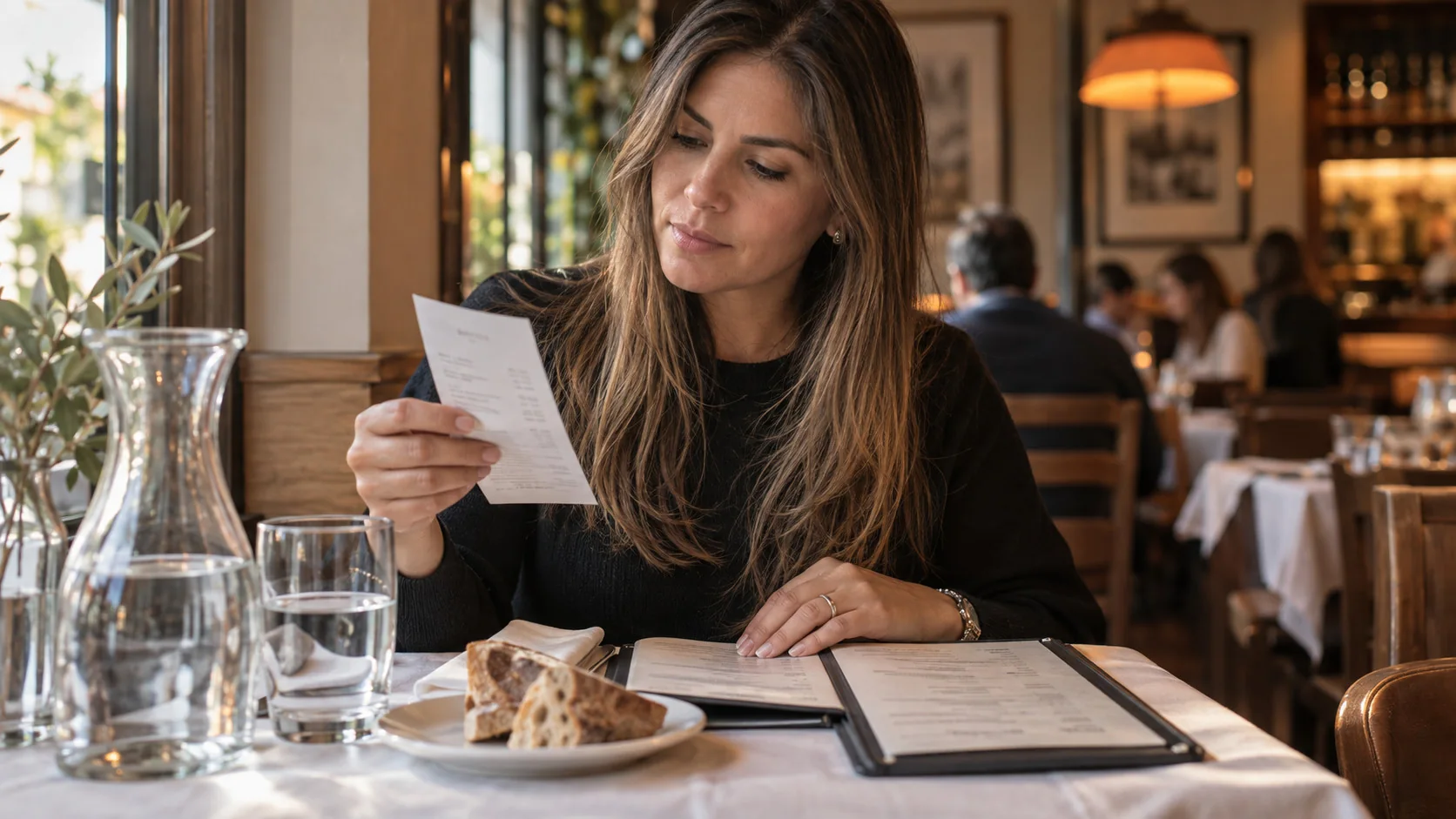
The bill arrives and there is a line nobody ordered. Sometimes it reads pan (bread), sometimes cubierto (cover charge). It is usually under three euros, which is exactly why most people pay it and walk out. In Spain the price of a meal is free and a restaurant can set it wherever it likes. What no venue can do is invent part of that price after you have eaten.
Short answer: a restaurant in Spain can charge you for the food and services you ordered or accepted, priced on the menu or on a visible sign before you ordered, with VAT included. It cannot charge you for something that appears for the first time on the bill. And advertising a charge does not rescue one the law forbids: a card surcharge is unlawful anywhere in the country, tap water is free for anyone who is eating there, bread is chargeable when the menu prices it, and a cover charge depends on the region you are sitting in.
Applicable law: Spain. The Italian and Portuguese versions of this guide cover their own countries. The sources and the limits of the checking are in how this guide was created.
Two readers at once here: the visitor or foreign resident reading a bill in a language that is not theirs, and the operator who wants to charge for extras without collecting a fine.
In 60 seconds
- The menu decides. What is priced there before you order can be charged, and what appears only on the bill cannot.
- Prices must be final, with VAT included. The note VAT not included is claimable for the difference.
- Bread and a terrace surcharge are lawful when priced in advance. In Andalusia the consumer authority also requires the surcharge to be a final amount and not a percentage of the bill.
- Free non-bottled water must be offered to anyone consuming in a bar or restaurant in Spain, and has been since 2022.
- A cover charge is banned by decree in Galicia and the Canary Islands, called unlawful by the Andalusian and Catalan authorities, and accepted in Madrid when announced.
- A booking deposit is lawful when disclosed, accepted, proportionate and deducted from the bill. Flat cancellation penalties are what regulators fine.
- A card surcharge is banned outright, and a card minimum needs a visible sign. Refusing cash below 1,000 euros is an infringement, or below 10,000 if you are a non-resident individual paying in a personal capacity.
- Leftovers travel home free since 2025, buffets and single-use plastic containers aside, and the tip is voluntary. A pre-selected amount on the card terminal is not express consent.
At Plattio, the restaurant management software that brings reservations and the digital menu together, this guide interests us for a practical reason. Almost no argument over a bill is about the amount. It is about not having seen it before ordering, and that is decided on the menu.
How this guide was created
Every statement was checked against two kinds of source wherever both exist: the rule itself, read in the BOE or in the regional gazette, and the reading the consumer authorities apply. Where only one of the two exists, this guide says so.
The state layer starts with the consolidated consumer law (TRLGDCU, Real Decreto Legislativo 1/2007). It goes on with Ley 7/2022 on waste, Ley 1/2025 on food waste, Real Decreto-ley 19/2018 on payment services and Ley 7/2012 on cash limits. The regional layer is the hospitality decrees of Galicia, the Canary Islands and Andalusia.
Then comes the reading the consumer authorities apply in practice. The pages opened for this guide are the Comunidad de Madrid FAQ, the Agència Catalana del Consum, Andalusia's Consumo Responde, the Basque agency Kontsumobide and the Banco de España.
Reading the law alone is not enough, and the cover charge proves it. No article of Spanish law contains the word cubierto. Several consumer authorities treat charging for it as unlawful, while another accepts it when announced. Where the letter and the authority diverge, this guide says so.
One caveat, the only one. This is an operational and consumer guide, not legal advice, and a specific case belongs with a consumer office or a lawyer.
Status of the rule (last verification: September 7, 2026). Every rule cited here was read in its official gazette that day, and every consumer authority page was opened the same day. This section is reviewed quarterly, and whenever one of four things happens: a region publishes a new rule on hospitality prices, article 8 of Ley 1/2025 changes, the cash payment regime changes, or a court rules on booking deposits.
What you should take away from this article
- Certainty: which charges are lawful, which are not, and which depend on where you are eating.
- Judgment: how to tell an unlawful charge from a merely annoying one.
- Process: how to get a wrong line off a bill, and how to complain when it stays.
- Templates: a menu notice for extras and a booking deposit clause, both bilingual.
What is the rule that decides almost everything?
One sentence decides most of these arguments. Article 20.1 c) of the TRLGDCU requires every commercial offer to state the full final price, taxes included. Any increase, discount or additional cost passed on to the consumer has to be itemized there. Article 60.2 c) repeats it as pre-contractual information, the total price with all taxes.
The other half is the infringement. Article 47 f) covers breaches of price rules and the unjustified imposition of conditions on unrequested services or minimum amounts, which is where an unannounced charge lands. Article 47 j) covers unfair terms, and article 47 ñ) refusing cash.
Article 49.1 sets the brackets: 150 to 10,000 euros for minor infringements, 10,001 to 100,000 for serious ones, 100,001 to 1,000,000 for very serious ones. Watch the numbering, because many Spanish sites still use the old one. Since May 28, 2022 the infringements live in article 47, their classification in article 48 and the amounts in article 49.
Each region also applies its own consumer law, sometimes with lower brackets. Andalusia sets 200 to 5,000 euros for minor infringements in article 74 of Ley 13/2003, and Catalonia caps them at 10,000 in article 333-1 of Llei 22/2010. Regional scales sit alongside the state ones, and some fall below the minimums of article 49 of the consumer law, which has been basic legislation since 2022. The final amount depends on which law the sanctioning body applies.
| Item or practice | Legal? | Condition | Source |
|---|---|---|---|
| Bread and appetizer | Yes, with condition | Priced on the menu, per person or per unit | TRLGDCU art. 20.1 c) |
| Cover charge or service | Depends on the region | Banned by decree in Galicia and the Canary Islands; unlawful for the Andalusian and Catalan authorities; allowed in Madrid if announced | Decreto 179/2011 art. 5.2; Decreto 90/2010 art. 11.3; Madrid FAQ |
| Ice | Yes, with condition | On the price list, with the amount | TRLGDCU art. 20.1 c) |
| Terrace surcharge | Yes, with condition | Both prices published before you order; in Andalusia, a final amount per item and never a percentage | TRLGDCU art. 20.1 c); in Andalusia, Decreto 198/1987 art. 6.2 and the Consumo Responde criterion |
| Tap water | No | Free non-bottled water must always be offered to anyone consuming | Ley 7/2022 art. 18.3 |
| Heating, cake cutting, sharing | Yes, with condition | Only when told and accepted before ordering | TRLGDCU arts. 20, 60 and 82.1 |
| Booking deposit or no-show charge | Yes, with condition | Disclosed, accepted, proportionate, deducted from the bill; in the Canary Islands a booking fee that is not deducted is banned | TRLGDCU arts. 60, 85.6, 87.2 and 87.6; Decreto 90/2010 art. 11.3 |
| Card surcharge | No | No exception for restaurants | RDL 19/2018 art. 35.3 |
| Card minimum | Yes, with condition | Visible sign before you consume | Banco de España |
| Charging only by card (refusing cash) | No | Cash accepted below the tax limit | TRLGDCU art. 47 ñ); Ley 7/2012 art. 7.Uno.1 |
| Charging customers for the toilet | Depends on the region | Catalonia says customers cannot be charged | Agència Catalana del Consum |
| Doggy bag container | No | Container free, buffets aside and single-use plastic aside | Ley 1/2025 art. 8 |
| Compulsory tip or service | No | Tipping is voluntary | Madrid FAQ; Consumo Responde |
| Prices without VAT or market price | Depends on the region | Final price with taxes always; the wording market price is banned by decree in Andalusia and the Canary Islands | TRLGDCU arts. 20.1 c) and 60.2 c); Decreto 198/1987 art. 8.2; Decreto 90/2010 art. 11.2 |
What changes from one region to another?
The rule about the advertised price is national, but each autonomous community has written its own layer on top, and that is where the same bill is lawful in one city and challengeable in another. This table holds only what we could read in the regional decree itself or on the official site of its consumer authority. Where we could not verify it, we say so.
| Region | Cover or service charge | Other verified local rule | Source |
|---|---|---|---|
| Galicia | Banned by decree: crockery, cutlery, glassware, linen and the table itself are a "common service, with no right to pass on any surcharge" | The decree allows an advance for bookings "of more than 20 diners" or for anyone asking to take "more than 40 % of its tourist capacity", and says nothing about smaller groups | Decreto 179/2011, arts. 4, 5.2 and 18 |
| Canary Islands | Banned by decree: nothing may be charged "for items such as bookings, covers, tables or similar" | The menu must state "IGIC included" and cannot price dishes at market quotation | Decreto 90/2010, art. 11 |
| Madrid | Allowed when advertised before you order | A booking deposit is valid when disclosed and accepted; Consumo fined a venue 10,100 euros for a 100 euro per head cancellation charge | Madrid consumer FAQ |
| Andalusia | The consumer authority treats it as an unlawful charge, though no article names it | Menu and advertised prices are final, and the expression "precio según mercado" is expressly banned | Consumo Responde and Decreto 198/1987, art. 8.2 |
| Catalonia | The Catalan consumer agency treats it as an unlawful charge | It also asks that the bill carry no wording suggesting a tip is compulsory | Agència Catalana del Consum |
| Balearic Islands | No local rule found | Free tap water has applied since 2019, conditional on the council or the water utility certifying that it is fit to drink | Ley 8/2019, art. 23.5 |
| Basque Country, Valencia and the rest | Not verified | Regional rules we have not checked yet; ask your own regional consumer authority | Pending verification |
A region in the last row is not a region without rules. It is one whose decree we have not read yet, and we would rather say so than assume it.
Item by item: what to do if you are charged, and how to charge without a fine
Is it legal to charge for bread?
Yes, when the menu prices it before you order, and no when it lands unasked and appears only on the bill. Andalusia's Consumo Responde puts it in one line. Charging for a bread service, breadsticks and the like is lawful as long as the venue informs in advance, clearly and visibly. The item also has to be included in the price list published to customers. Madrid's consumer FAQ accepts 1.50 euros for bread and appetizer per person when it is on the menu, and Kontsumobide adds that bread you did not ask for can be sent back.
If you are the diner. Ask for the line to come off when the charge was never announced.
If you are the restaurant. Give bread its own priced line with the unit stated, and say on the menu when the appetizer is on the house.
Can they charge you a cover charge (cubierto) or a service charge?
It depends on the region, and this is the most disputed line of the guide. No state article bans the word, so the ban arrives at three strengths. Galicia bans it by decree. Article 5.2 of Decreto 179/2011 treats the use of the crockery, cutlery, glassware, table linen and the table itself as a common service. No surcharge can be passed on for any of it. Article 11.3 of Decreto 90/2010 bans charging in the Canary Islands for concepts such as reservations, covers or tables. Andalusia and Catalonia have no such article, and their consumer authorities call the charge unlawful anyway. In the Basque Country the only public position is a Kontsumobide blog post from 2018, and Madrid's official FAQ answers the other way, allowing the surcharge when it is announced.
If you are the diner. In Galicia and the Canary Islands the line is claimable even if the menu carried it. In Andalusia and Catalonia the consumer authorities treat it as unlawful too, although with no article behind it. Everywhere else, it is claimable when it was not announced.
If you are the restaurant. Build the cost of the table into the price of the dishes, because a separate cubierto line reaches the press and the complaint file at once.
Can they charge you for ice?
Yes, when the price list says so. Nothing in Spanish law mentions ice, so the general rule of article 20.1 c) applies. The surcharge exists only if it was published before you ordered, as a separate line or as two prices for the same drink. In August 2025 consumer association FACUA reported a café for adding ten cents per glass of ice that was not on the price list, and the case reached the national press.
If you are the diner. Check the drinks page, and ask for the line to come off when the ice is not priced there.
If you are the restaurant. Ten cents is not worth a complaint file. Publish the surcharge or absorb it.
Is a terrace surcharge legal?
Yes, when the terrace price is published before you order and shown on the bill. Andalusia has had a written rule since 1987. When the bar and the table cost different amounts, both prices must appear in the price list (article 6.2 of Decreto 198/1987). Its consumer authority goes one step further, because Consumo Responde says the increase has to be stated as a final price and cannot be set as a percentage. That extra condition comes from the Andalusian authority, and no state rule says the same. Madrid and Catalonia ask only for the price of each area to be visible. A Madrid restaurant made headlines in November 2025 for adding 10 percent for terrace service to a bill of 205.30 euros.
If you are the diner. Photograph the menu. A percentage added at the end is claimable with certainty in Andalusia, and arguable elsewhere because it stops you knowing the amount before ordering.
If you are the restaurant. Two price columns, room and terrace, or a sign at the terrace entrance with the fixed amount per item.
Do they have to give you free tap water?
Yes, for anyone consuming in the venue. The duty is to offer free non-bottled water alongside what you order, not to open a tap to passers-by. Article 18.3 of Ley 7/2022 says that hospitality venues must always offer their customers non-bottled water free of charge. The wording adds that it goes as a complement to the venue's own offer. The phrase to quote in a complaint file is the Spanish original, "se tendrá que ofrecer siempre a los consumidores [...] la posibilidad de consumo de agua no envasada de manera gratuita". The rule was born in the waste law, to cut down single-use packaging.
Bottled or filtered water can still be sold at a published price, with the free option alongside. The Balearic Islands imposed the same duty in 2019 in article 23.5 of Ley 8/2019, provided the town council or the water supplier guarantees that the water is fit to drink. Charging for the act of serving it is a separate battle. FACUA reported a venue in Cantabria in 2025 for three euros of water service, with no published decision found on those files.
If you are the diner. Ask for agua del grifo, tap water, in those words. Claim any charge for the water or the glass under article 18.3, and a water service line too, although no published decision on those complaints has been found.
If you are the restaurant. Keep a jug ready and tell the floor team. Not offering it is a minor infringement of Ley 7/2022, under the catch-all of article 108.4 d). The fine reaches 2,000 euros under article 109.1 c).
Can they charge for heating food, cutting a cake or sharing a dish?
Yes, when you were told the price before accepting the service, and no when the charge appears for the first time on the bill. No rule covers these extras. They live under the duty of prior information in articles 20 and 60. Article 82.1 adds that a practice not expressly consented to, creating a significant imbalance in bad faith, is unfair. The cases that reach the press are all about surprise. A venue in Ibiza charged 27 euros for cutting a cake brought from home. One in Huelva charged three euros per guest at a table with two babies.
If you are the diner. Ask what corkage or cake cutting costs before handing anything over.
If you are the restaurant. Write the policy on the menu with an amount, and skip charging a family for warming a bottle.
Is it legal to take a deposit and keep it if you do not turn up?
Yes, when four conditions hold together, and this is the charge with the largest fines attached. Madrid's consumer FAQ accepts it when the venue has informed the consumer beforehand, clearly and comprehensibly, and the consumer has expressly accepted that condition when making the booking. The Catalan agency accepts an advance to be deducted from the final bill, and a compensation that is not disproportionate. Its director called a booking fee that is not deducted from the bill invalid when a Girona venue charged 10 euros a head for the table alone.
The consumer law does the rest. Article 85.6 makes a disproportionately high penalty unfair. Article 87.2 rejects keeping the customer's money without an equivalent payment when the venue pulls out, and article 87.6 rejects compensation unrelated to real damage.
One regional caveat. Article 11.3 of Decreto 90/2010 bans charging in the Canary Islands for concepts such as reservations, covers or tables. A booking fee that is not deducted from the bill has an express prohibition there. A deposit that is discounted from what you eat is not a charge for reserving.
Galicia is the one region with a written rule. Article 18 of Decreto 179/2011 expressly allows an advance for bookings of more than 20 diners, or for those taking up more than 40 percent of the venue's capacity. It goes as a deposit deducted from the services provided. For smaller parties the decree says nothing, and the usual reading is that it cannot be required, but the Galician consumer authority has published no criterion.
In December 2025 Madrid's consumer directorate fined a restaurant 10,100 euros for charging 100 euros per person to anyone canceling with less than a day's notice. The public note gives neither the article applied nor whether the decision is final.
If you are the diner. Keep the booking confirmation, and claim a refund under articles 85.6 and 87 when you accepted no written terms or the penalty is unrelated to the meal.
If you are the restaurant. Charge a deposit rather than a penalty. Plattio's reservation management takes a fixed amount or a percentage of the estimated spend when the booking is confirmed. The amount is then deducted or refunded according to your own cancellation policy. Empty tables as a wider problem are another conversation, covered in the guide to reducing no-shows.
Can they add a surcharge for paying by card?
No, and there is no version of this that works. Article 35.3 of Real Decreto-ley 19/2018 is blunt. Payees of payment operations may not require the payer to pay charges or additional fees for using any payment instrument. The original, worth quoting on a complaint form: "los beneficiarios de las operaciones de pago no podrán exigir al ordenante el pago de gastos o cuotas adicionales por la utilización de cualesquiera instrumentos de pago." The Banco de España repeats it on its customer portal. Article 35.4 allows the reverse gesture, a discount for using a particular means of payment.
If you are the diner. A line reading card surcharge or terminal fee is claimable in full.
If you are the restaurant. Advertise a cash discount if you want to steer payments, never a card fee.
Is a card minimum legal, and can a bar refuse cash?
A minimum is allowed with a visible sign, and refusing cash is an infringement. The Banco de España notes that payment rules give the minimum no explicit treatment, so it is not prohibited, provided it is communicated through signs visible to the public. No law obliges a venue to accept cards. Cash runs the other way. Article 47 ñ) makes it an infringement to refuse cash within the limits of anti-fraud tax rules. Article 7.Uno.1 of Ley 7/2012 sets that limit at 1,000 euros where one party acts as a business. It rises to 10,000 when the payer is an individual who proves no tax residence in Spain and is not acting as a business. The ban bites at amounts equal to or above the limit, so cash below it must be accepted. One warning for operators: article 47 f) punishes the unjustified imposition of minimum amounts, so a minimum with no sign is a complaint waiting to happen.
If you are the diner. No sign, no minimum. Refusing your notes on a bill below the limit is an infringement.
If you are the restaurant. A sign reading card payments from X euros, cash always accepted, and a warning before the first order when you have no card terminal.
Can they charge you to use the toilet?
It depends on the region, and on whether you are a customer. No state rule governs toilet access in hospitality. Catalonia's consumer agency is explicit that hospitality venues cannot charge their customers any amount for using the toilets. No equivalent published position has been found elsewhere, where the general reading is that the toilet forms part of the service you already paid for. For non-customers there is no obligation to open the door.
If you are the diner. As a paying customer a toilet charge is claimable, and without consuming the venue can say no.
If you are the restaurant. Do not charge customers, and put any restriction for passers-by on a clear sign.
Can they charge you for the container to take leftovers home?
No, with one exception. Article 8 of Ley 1/2025 obliges hospitality businesses to let customers take home food they have not eaten, at no additional cost. The packaging has to be suitable for food, and either reusable or easily recyclable. It also obliges them to advertise the right in the venue, preferably on the menu. Self-service buffets are outside.
Two dates matter, because the press keeps getting them wrong. The law was published in the BOE on April 2, 2025, and its twentieth final provision names January 2, 2025, a date earlier than publication. So in practice article 8 has applied since April 2025, and the one-year postponement with its size exemptions touches only article 6 on prevention plans. The exception is plastic. Article 55.2 of Ley 7/2022 obliges venues to charge for the single-use plastic cups and containers listed in part A of its annex IV. The price has been shown as a separate line on the bill since January 1, 2023. Not charging for them is itself a minor infringement under article 108.4 e). The ministry in charge of the law confirms both points in its official question and answer paper. Question 27 states that the packaging cost refers to single-use plastic containers «and not to any other kind of packaging». Question 29 settles the date, admitting the drafting slip and answering that it «has no practical effect», that the law is not retroactive and that its obligations apply from publication.
If you are the diner. A recyclable container is free, a single-use plastic one is charged, and the food is never charged twice.
If you are the restaurant. Keep cardboard or recyclable containers and print the right on your menu, because it costs a cent and removes an argument.
Is a service charge or a tip added to the bill compulsory?
No. Madrid's consumer FAQ answers the question about a suggested tip percentage printed on a bill with a flat no, because a tip in Spain is not compulsory. Consumo Responde describes it as a voluntary decision that cannot be imposed. The Catalan agency asks venues to avoid printing receipt messages that could make customers believe they are obliged to tip. No rule governs tipping in Spain, so an added service line is judged under the same articles as the cover charge. Preselected percentages on card terminals in Madrid ended up in the papers in 2026.
If you are the diner. Ask for the tip or service line to be removed, and complain afterwards with the bill when it stays.
If you are the restaurant. Ask for the tip, never invoice it, and let the card terminal default to no tip.
Can the menu show prices without VAT or say market price?
No to the first, and it depends on the region for the second. The final price with all taxes is the state rule, in articles 20.1 c) and 60.2 c). Catalonia's agency rejects the note IVA no inclòs, VAT not included, outright. Kontsumobide treats it as reportable, and Consumo Responde says prices without taxes are not lawful. Consumer organization OCU takes a softer line and accepts the note when it is stated expressly, and the state law prevails over that reading.
Two regions go further than the state rule. Andalusia bans the phrase itself: article 8.2 of Decreto 198/1987 says the expression "precio según mercado" or anything similar is expressly prohibited on menus, price lists and any advertising, so pricing by the kilo does not rescue the wording there. The Canary Islands add two duties in Decreto 90/2010. Menus must state IGIC incluido, the local VAT included (article 11.4). Prices may not be set by market quotation, or by any variable that makes the final amount hard to know (article 11.2). Madrid's FAQ is clear that a QR code cannot be the only format and that an accessible alternative has to exist, such as a printed menu or a board. Whatever the support, the bill has to itemize what you consumed and match the menu, and that receipt has rules of its own, unpacked in the VeriFactu guide.
If you are the diner. Compare bill and menu before paying, because a price gap or a VAT not included note is claimable for the difference.
If you are the restaurant. Change every support the same day, printed menu, digital menu, website and board, and charge the price the customer saw.
How do you complain if you were charged something you should not have been?
Say it at the table first. Point at the line, say it was not on the menu and ask for it to be removed. Most cases end there.
If the line stays, pay and complain afterwards: refusing does not prove you right, and it can end with the police at the door and the argument on much worse ground for you. Ask for an itemized bill and photograph the menu and any price sign, because everything that follows depends on proving what was announced before you ordered.
Then ask for the hoja de reclamaciones, the official complaint form. Every bar and restaurant in Spain must hold them and hand one over on the spot, under rules each region issues separately. Fill in the facts with dates and amounts, and ask for a refund. Name the article you rely on. Article 20.1 c) of the TRLGDCU covers an unannounced charge, and article 18.3 of Ley 7/2022 the water. Article 35.3 of Real Decreto-ley 19/2018 covers a card surcharge, and article 8 of Ley 1/2025 the container. You do not need fluent Spanish to fill one in. If the venue refuses to hand you the form, call the local police to record the refusal, which is an infringement in itself.
The venue answers within the period its region sets, usually between ten working days and one month. The Canary Islands give a maximum of one month under article 6 d) of Decreto 90/2023. Then take the form to the municipal consumer office (OMIC) or the regional consumer authority, which mediates for your refund and can open an infringement file. Associations such as OCU and FACUA handle members' complaints, and they are behind the cases in this guide that ended in a fine.
Consumer arbitration is free and voluntary for the business. Under article 36.2 of the arbitration regulation approved by Real Decreto 713/2024, a venue that is not signed up has ten working days to accept or reject. Court is the last stop, and since April 3, 2025 article 5 of Ley Orgánica 1/2025 requires proof of a prior attempt to settle, which an answered complaint form usually satisfies.
Time limits help you, with a caveat. Under article 52 of the consumer law minor infringements expire after one year, serious ones after three and very serious ones after five. Each region sets its own periods, and Madrid's Ley 11/1998 gives five years for all of them.
How to advertise your extras so you can charge them: five steps
1. List everything you charge on top
Bread, ice, terrace, corkage, cutting a cake, heating food, an extra plate for sharing, the booking deposit. Write the list before you touch the menu, because anything missing from it cannot legally reach a bill.
2. Put every item on the menu with its final price
Price with VAT included and a clear unit, per person or per piece, on the printed menu and on the digital one, before the customer orders. Skip the words cubierto and servicio as separate lines, and skip market price. A digital menu earns its keep here, because the surcharge sits next to the dish with its own price and any change is published instantly. It complements the printed menu rather than replacing it, since a QR code cannot be the only support.
3. Ask before serving anything that has its own price
Bread, ice, bottled water and an extra plate for sharing are offered before they reach the table, and free non-bottled water is always available on request. If the table says no, the item goes back and nothing is charged.
4. Make each extra a line of the bill with the same name and price as the menu
A bill that matches the menu is your defense in a complaint file, and the mismatch is the first thing an inspector looks for. Hand over leftovers at no cost, and charge for the single-use plastic container as a separate line whenever you use one, because the law ties that charge to the type of packaging and not to whether you had an alternative. A surprise on the bill also has a second life as a one-star review, covered in the guide to getting more Google reviews.
5. Show and get acceptance of your deposit terms before confirming a booking
State the amount, when it is charged, the free cancellation window and what happens if the table goes unused. Keep the amount proportionate, deduct it from the final bill and refund it inside the published window. Compensate the customer with an equivalent amount when you are the one who cannot provide the table. Keep the proof of acceptance, because without it a charge is hard to defend against a complaint or a chargeback.
Download the two templates. Menu notice for extras and booking deposit clause, each with a Spanish and an English version in the same file. Replace the bracketed fields and adapt the amounts to your average bill.
How Plattio fits into this flow
Two pieces of this guide are product problems. The digital menu holds the dishes with their prices, the sizes with their own price, the set lunch at a closed price and the allergens in view. Every change is published instantly, so a surcharge becomes a line the customer read before ordering.
Reservation management covers the other half. The deposit is a fixed amount or a percentage of the estimated spend, charged when the booking is confirmed. It is then deducted from the bill or refunded according to the cancellation policy the restaurant sets.
What this guide does not cover
Everything here reflects the rules in force on September 7, 2026, and hospitality prices are heavily regional, so your community may have a decree that changes the answer. Four points remain pending confirmation, and they are flagged as such:
- Whether charging a paying customer for the toilet is unlawful outside Catalonia.
- How the FACUA complaints about water service charges ended.
- The deadline each region gives a venue to answer a complaint form, beyond the Canary Islands.
- The Valencian hospitality decree of 2023, whose official text could not be read.
Practical summary
- A charge announced with its price before you order is lawful, and a charge that debuts on the bill is not.
- Prices are final with VAT included, and the bill has to itemize what you consumed.
- The cover charge depends on your region. The terrace surcharge must be published for each area, and in Andalusia it cannot be a percentage.
- Tap water and the doggy bag are free, and the tip is voluntary.
- A card surcharge is banned, and a card minimum needs a sign. Cash must be accepted below 1,000 euros, or below 10,000 if you are a non-resident individual paying in a personal capacity.
- A booking deposit stands on four legs, disclosed, accepted, deducted from the bill and proportionate.
- The hoja de reclamaciones is compulsory in every venue, and refusing to hand it over is an infringement in itself.
- Pay, keep the bill, photograph the menu, ask for the complaint form.
Let the bill hold no surprises
Almost every dispute in this guide starts the same way, with a customer discovering a price after eating. Publishing your extras is cheaper than defending them. And for anyone eating out in Spain, one habit settles most of it: read the menu before the bread arrives.
About the author
Carlos Bergara
Operations and reservations specialist for restaurants
Carlos Bergara writes about operations, reservations, and analytics for restaurants on the Plattio blog. His articles draw on patterns the team observes in reservation management, waitlists, orders, and service metrics, applying operational judgment to front-of-house decision-making.
Frequently asked questions
Can a restaurant in Spain charge me for bread?
Yes, when the price of the bread is on the menu or on a visible sign before you order, stated per person or per unit. Andalusia's consumer service says that charging for a bread service, breadsticks and the like is lawful as long as the venue informs in advance, clearly and visibly, and the item is included in the published price list. The Basque consumer agency adds that bread placed on the table without being asked for can be sent back. If it appears for the first time on the bill, ask for it to be removed.
Is a cover charge (cubierto) legal in Spain?
It depends on the region, and no state law uses the word cubierto. Galicia bans it by decree, because article 5.2 of Decreto 179/2011 treats crockery, cutlery, glassware, table linen and the table itself as a common service with no right to pass on any surcharge. Article 11.3 of the Canary Islands' Decreto 90/2010 bans charging for reservations, covers or tables. The consumer authorities of Andalusia and Catalonia call it an unlawful charge without a specific article behind it, while Madrid's official consumer FAQ accepts it as a surcharge when it is announced on the menu or on a visible sign.
Do restaurants in Spain have to give me free tap water?
Yes, to anyone consuming in the venue. Article 18.3 of Ley 7/2022 requires hospitality venues to always offer customers the possibility of consuming non-bottled water free of charge, as a complement to the venue's own offer. The venue may still sell bottled or filtered water at the price on the menu, and the free option has to exist alongside it. In the Balearic Islands the same obligation has applied since 2019 under article 23.5 of Ley 8/2019, provided the town council or the water supplier guarantees that the water is fit to drink.
Can a restaurant charge me extra for paying by card?
No. Article 35.3 of Real Decreto-ley 19/2018 states that payees may not require the payer to pay charges or additional fees for using any payment instrument, and the Banco de España repeats it in plain words on its customer portal. A discount for paying by another means is allowed under article 35.4, so a cash discount is lawful and a card surcharge is not. A line reading card surcharge on your bill can be claimed back in full.
Is a minimum spend for card payments legal in Spain, and can a bar refuse cash?
A card minimum is not banned, provided it is announced on a visible sign before you consume, according to the Banco de España, which notes that payment rules give no explicit treatment to the question. There is no law forcing a venue to accept cards at all. Refusing cash is different: article 47 ñ) of the consumer law makes it an infringement to refuse cash within the limits set by anti-fraud tax rules. Article 7.Uno.1 of Ley 7/2012 sets that limit at 1,000 euros for operations where one party acts as a business, rising to 10,000 euros when the payer is an individual who proves they have no tax residence in Spain and is not acting as a business. The ban bites at amounts equal to or above the limit, so cash below it must be accepted.
Is it legal for a restaurant in Spain to take a deposit and keep it if I do not show up?
Yes, under four conditions that the consumer authorities apply together: clear information before booking, express acceptance by the customer, a deposit that is deducted from the final bill, and a penalty proportionate to the actual harm. Madrid's consumer FAQ accepts the charge when the venue has informed the consumer clearly and comprehensibly beforehand and the consumer has expressly accepted that condition when booking. Articles 85.6, 87.2 and 87.6 of the consumer law make disproportionate penalties, one-sided retentions and compensation unrelated to real damage unfair terms. One regional caveat: article 11.3 of Decreto 90/2010 bans charging in the Canary Islands for concepts such as reservations, covers or tables, so a booking fee that is not deducted from the bill has an express prohibition there, while a deposit discounted from what you eat is not a charge for reserving.
Can a restaurant charge me for the container to take my leftovers home?
No. Article 8 of Ley 1/2025 obliges hospitality businesses to let customers take away food they have not eaten at no additional cost, in reusable or easily recyclable packaging, and to say so clearly in the venue, preferably on the menu. Self-service buffets are excluded. The one charge that survives is the single-use plastic container: article 55.2 of Ley 7/2022 obliges venues to charge for the plastic cups and containers listed in part A of its annex IV, with the price shown as a separate line on the bill since January 1, 2023. Not charging for them is itself a minor infringement under article 108.4 e).
Is tipping compulsory in Spain?
No. Madrid's consumer FAQ answers the question about a suggested tip percentage printed on a bill with a flat no, and Andalusia's consumer service describes tipping as a voluntary decision of the consumer that cannot be imposed. Catalonia's consumer agency goes further and asks venues to avoid printing messages on receipts that could make customers believe they are obliged to tip. A service percentage added to the bill is treated as the cover charge question, not as a tip.
Can a restaurant show prices without VAT or say market price?
No on the first point. Article 20.1 c) of the consumer law requires the full final price including taxes, and article 60.2 c) repeats it for pre-contractual information. The note IVA no inclòs, VAT not included, is rejected by the Catalan consumer agency and by the Basque and Andalusian authorities. On market price, two regions ban the wording outright. Andalusia forbids the expression «precio según mercado» or anything similar on menus, price lists and advertising in article 8.2 of Decreto 198/1987, and the Canary Islands forbid setting prices by market quotation or any variable that makes the final amount hard to know in article 11.2 of Decreto 90/2010. Menus there must also state IGIC incluido, the local Canary VAT included, under article 11.4.
What can I do if a restaurant in Spain charges me for something that was not on the menu?
Ask for the line to be removed, and if it is not, pay, keep the itemized bill and ask for the hoja de reclamaciones, the official complaint form that every venue must hold. Photograph the menu and the price sign as evidence, since the whole case turns on what was announced before you ordered. You then file the form with the municipal consumer office (OMIC) or the regional consumer authority, which can mediate for your refund and open an infringement file separately.
Keep exploring the cluster
Related articles
Operations
VeriFactu in Spanish hospitality: when it becomes mandatory for bars and restaurants and how to prepare your POS
A guide verified against the BOE: the real VeriFactu dates after the postponement to 2027, what the regulation demands of a bar's POS, the fines at stake, and how to get your venue ready without waiting for December.
Operations
Digital time tracking in Spanish hospitality: what's mandatory today and what's about to change
A no-alarmism guide to working time records in Spanish hospitality: what the law requires today, the real fines, where the digital clock-in royal decree stands, and how to comply with split shifts, part-timers, and weekend extras.
Operations
How to manage a restaurant waitlist without losing tables
An operational guide with a protocol, template, metrics, and criteria to manage a restaurant waitlist without losing tables or breaking your reservation logic.