
Practical guide
In Spanish hospitality, working time records, which many payroll firms and apps call time and attendance, have become a mix of fear and noise: headlines announcing fines of 10,000 euros per worker, blogs treating a royal decree that doesn't exist yet as if it were in force and, meanwhile, restaurants still jotting down hours on a piece of paper next to the till. This guide separates what Spanish law requires today from what is about to change, and translates it into the reality of a restaurant: split shifts, part-timers, weekend extras, and closes that never end on time.
Short answer: since May 2019, every bar and restaurant in Spain with employees must record daily the specific start and end time of each person's working day, keep those records for 4 years, and have them available to the Labour Inspectorate. As of July 2026 the medium can be paper, Excel, or a digital system; the new royal decree that plans to eliminate paper is still in the approval process and is not in force. The real fine for non-compliance runs from 751 to 7,500 euros per company, not 10,000 per worker.
In 60 seconds
Working time records in Spanish hospitality, the essentials:
- Mandatory since May 12, 2019 for every company in Spain, from the first employee.
- It must reflect the specific start and end time of each working day, not the theoretical contract schedule.
- It's kept for 4 years and must be producible at the venue if the Labour Inspectorate asks.
- As of July 2026, paper, Excel, or an app are valid; the mandatory digital clock-in royal decree is not yet in force.
- The current penalty is 751 to 7,500 euros per company, as a serious infringement.
- Part-time contracts carry a reinforced obligation: a monthly summary of hours alongside the payslip; without a record, they're presumed full-time.
- Split shifts are clocked with four punches, and mise en place and closing are working time.
At Plattio, the restaurant management software that brings reservations, shifts, and clock-in (time and attendance) together in a single system, we work with venues where the same pattern repeats: the one that sets up its records once, with written rules, spends minutes a month on compliance; the one that improvises ends up reconstructing working days when the Labour Inspectorate shows up.
How this guide was created
This guide rests on primary sources: Real Decreto-ley 8/2019 (the royal decree-law) that introduced article 34.9 of the Estatuto de los Trabajadores (Workers' Statute), the consolidated text of the Estatuto, the LISOS (Spain's law on labour infringements and penalties), the Ministry of Labour's guide on working time records, and the official draft of the new royal decree submitted to public consultation, plus the annual reports and campaigns published by the Inspección de Trabajo y Seguridad Social (Labour Inspectorate).
Two honest caveats. First: the new royal decree's approval process is still moving and can change; that's why this guide dates every statement about its status and will be updated when the text is published in the BOE (Official State Gazette). Second: this is an operational guide for restaurant operators, not legal advice; for your specific case (provincial collective agreement, company-level agreements, open proceedings), talk to your gestoría or labour advisor.
What you should take away from this article
- Certainty: what is enforceable today and what is still a draft, with dates and sources.
- Judgment: how the record applies to the cases that only exist in hospitality, from the split shift to the Saturday extra.
- Process: how to set up a record that survives a Labour Inspectorate visit without slowing down service.
- Template: a downloadable starting point you can use this very week.
Is clocking in mandatory in a restaurant? What the law requires today
Since May 12, 2019, article 34.9 of the Estatuto de los Trabajadores (Workers' Statute) requires every company in Spain to guarantee a daily record of working time, which must include "the specific start and end time of each worker's working day." The obligation was introduced by Real Decreto-ley 8/2019; two months later, the Court of Justice of the EU judgment of May 14, 2019 (case C-55/18, CCOO v Deutsche Bank) consolidated the same criterion at European level: every company must have an objective, reliable, and accessible system to measure each worker's daily working time.
Who is bound by the working time record?
The working time record binds every company in Spain, regardless of size, sector, or how the work is organized. There is no headcount threshold: a bar with two waiters is just as bound as a group with twenty venues. Outside the obligation: self-employed owners without employees, worker-members of cooperatives, and the special employment relationship of senior executives.
In hospitality this means the obligation also covers reinforcement staff: the Saturday extra, the seasonal hire, and the student on a weekend part-time contract. From day one and from the first worker.
What the record must contain
The record must reflect the specific start and end time of each working day, for every person, every day worked. The Ministry of Labour's guide clarifies two nuances that matter a lot in hospitality:
- A record that merely reproduces the theoretical schedule of the contract or the shift plan is not valid: it must reflect what actually happened.
- Breaks within the working day can be omitted only when they are clearly and globally predetermined (by law, collective agreement, or contract). If they aren't, the Ministry itself recommends the record template capture them, so the daily count is measurable.
Today the rule does not require recording the nature of each hour or breaks to the hour and minute: that level of detail belongs to the draft of the new royal decree, which we'll get to below.
How long you must keep it and who can ask for it
Records are kept for 4 years and remain available to workers, their legal representatives, and the Inspección de Trabajo y Seguridad Social (Labour Inspectorate). In inspection practice, "available" means the record must be producible immediately at the workplace itself.
On top of that, two obligations that predate 2019 remain in force and are the ones that generate the most proceedings in hospitality:
- Part-time work (art. 12.4.c of the Workers' Statute): day-by-day records, monthly totals, and a copy of the monthly summary of hours handed to the worker along with the payslip, keeping those summaries for a minimum of 4 years. If this is breached, the contract is presumed full-time unless proven otherwise.
- Overtime (art. 35.5 of the Workers' Statute): day-by-day records and totals for each pay period, with a copy of the summary for the worker. Overtime must also be paid or compensated, included in Social Security contributions, and stay within the cap of 80 hours per year.
What is the fine for not keeping working time records? The real amounts
Not keeping a working time record, or keeping one that doesn't reflect real hours, is a serious infringement under article 7.5 of the LISOS. The current amounts, set by Law 10/2021, are these:
- Minimum degree: 751 to 1,500 euros.
- Medium degree: 1,501 to 3,750 euros.
- Maximum degree: 3,751 to 7,500 euros.
Two clarifications almost no headline makes. First: the penalty is assessed per company (the Labour Inspectorate can assess it per workplace), not per affected worker. Second: the fine "of up to 10,000 euros per worker" repeated across many blogs belonged to the working time reduction bill that Spain's Congress rejected on September 10, 2025; it is not in force, and the new royal decree cannot resurrect it, because a regulation cannot modify the penalties set by a law.
The direct fine, moreover, is rarely the biggest cost. If the record doesn't exist or isn't reliable, the Labour Inspectorate reconstructs working days from circumstantial evidence (shift plans, POS tickets, till closes, witnesses), and from there flow regularizations of unpaid, uncontributed overtime and, for part-timers, the presumption of full-time work with retroactive effects on wages and Social Security contributions.
Two court rulings show what that looks like in practice, both in accommodation and food service:
- In 2024, the TSJ de Madrid (Madrid's high court of justice) ordered a hostel to pay 67,036 euros plus 10% late-payment interest in overtime and night hours claimed by a worker: the company kept no working time record, so the burden of proving the hours fell on it and the claim was upheld in full (appeal 1038/2023).
- The TSJ de Castilla y León (the region's high court of justice) ordered a restaurant to pay 6,597 euros in wage differences to a waitress hired half-time who was working full-time: without a record, the presumption of full-time work applies (judgment of May 24, 2019, appeal 272/2019).
When does mandatory digital clock-in come into force? Where the royal decree stands
Status of the rule (last verified: July 9, 2026): the royal decree on digital working time records is not in force. It has not been approved by the Council of Ministers or published in the BOE, and there is no confirmed entry-into-force date. Article 34.9 of the Workers' Statute still applies in its 2019 wording, which allows paper, spreadsheets, or digital systems. This section is reviewed every week for as long as the approval process lasts.
The verifiable timeline is this:
- September 10, 2025. Spain's Congress rejects the bill to reduce the working week to 37.5 hours. With it fall the statutory digital record and the per-worker penalty.
- September 30, 2025. The Council of Ministers authorizes the urgent processing of a royal decree that rescues the digital record through regulation, developing articles 12, 34, and 35 of the Workers' Statute.
- October 2025. The draft goes through the public consultation stage.
- March 23, 2026. The opinion of the Consejo de Estado (Council of State) becomes known: unfavorable. Among its objections: part of the content exceeds what a regulation can govern, the implementation cost was underestimated (it puts it at some 867 million euros for 1.35 million companies and 15.6 million workers, around 55 euros per person), and the 20-day adaptation period is "manifestly insufficient." The opinion is mandatory to request but not binding.
- July 2, 2026. The Secretary of State for Labour states that the reworked text will be approved "in one of the Council of Ministers meetings before the holidays," that is, before August 2026.
The operational translation: approval looks like a matter of weeks, but neither the date nor the final adaptation period is confirmed. The opposite scenario also exists: approval could slip to autumn, or the adaptation period could stretch well into 2027. That is what has happened with the VeriFactu invoicing regulation, which has already had two postponements approved. On October 5, 2026, the Ministerio de Hacienda (Spain's Ministry of Finance) announced a third one, until October 2028, with no rule approved yet. Neither possibility justifies waiting, because the daily record is already mandatory today. Distrust any page that gives you an exact countdown; when the royal decree lands in the BOE, we will update this guide with the final text and the real deadlines.
What will change when the royal decree comes into force
The draft submitted to public consultation sketches a much more demanding record than the current one. This table summarizes the difference between what you can be required to do today and what the new text would require:
Obligation | Today (art. 34.9 of the Workers' Statute, 2019) | Draft of the new royal decree |
|---|---|---|
Medium | Free choice: paper, spreadsheet, or digital, if it's objective, reliable, and unalterable | Digital mandatory; paper only as a temporary exception during a technical incident |
Content | Specific start and end time of each working day | Hour and minute of start and end, the ordinary, overtime, or complementary nature of the hours, on-site or remote work, and daily and monthly totals |
Breaks | Can be omitted if clearly and globally predetermined | Start and end of every break that doesn't count as effective working time |
Who clocks in | The mechanism isn't specified | The worker themselves, personally, directly, and immediately at every start and end |
Modifications | The record must be unalterable and reliable | No entry is modified without authorization from company and worker, with a clear and indelible trail of the change and its author |
Labour Inspectorate access | In person: immediate production at the workplace | Plus remote, immediate access at any time, with provision for a telematic connection with the Labour Inspectorate |
Team | No specific training obligations | Staff training on the system, counted as working time and at the company's expense |
What the draft does not change: the penalties. A royal decree cannot modify the LISOS, so until Parliament passes another law, the fine will remain what it has always been: 751 to 7,500 euros per company.
The myths making the rounds (and what the rules actually say)
A good share of what gets published on this topic mixes up different rules. These are the most repeated mistakes:
- "Digital clock-in is already mandatory." False as of today: the royal decree hasn't been published in the BOE. What is mandatory is the 2019 daily working time record, in any reliable medium.
- "Fines of up to 10,000 euros per worker." That amount came from the bill rejected in September 2025. The current penalty is 751 to 7,500 euros per company.
- "You have 20 days to adapt." That was the draft's deadline, and the Consejo de Estado (Council of State) called it manifestly insufficient. The final deadline won't be known until the text is published.
- "The working time record is the same thing as the 37.5-hour week." They're different rules. Reducing the working week requires a law and was rejected; the maximum legal working week remains 40 hours on an annual average.
- "Small bars are exempt." No headcount threshold exists, and in hospitality the Labour Inspectorate checks this as a priority.
- "You already have to record every break to the hour and minute." That detail is from the draft, not the rule in force. Today the start and end of the working day is enough, with breaks handled according to your collective agreement.
The edge cases that only exist in hospitality
Generic time-tracking guides are written for offices. A restaurant has six situations no office has.
Split shift: four punches, not two
If a waiter works 12:00 to 16:00 and 20:00 to 24:00, the record must show four punches. Recording only the first clock-in and the last clock-out would count the four hours of the break as worked, and a record that doesn't reflect real hours is an unreliable record: for the Labour Inspectorate, it's equivalent to having none. Besides, the split-shift break is rarely "clearly and globally predetermined" when schedules change every week, so it can't simply be omitted.
Part-time: the reinforced obligation that generates the most proceedings
The typical reinforcement contract in the dining room is part-time, and there the obligation is double: day-by-day records plus a monthly summary handed over with the payslip. The classic fraud the Labour Inspectorate pursues in hospitality is the 20-hour contract with a real 40-hour week. Without a reliable record, the law plays against the restaurant: the contract is presumed full-time and the regularization of wages and contributions runs backwards. Complementary hours, if there are any, need a written agreement and must be identified as such in the record and on the payslip.
Weekend extras and seasonal staff
The Saturday extra has the same record-keeping rights as the head chef: the obligation is born on day one, even if the contract lasts 48 hours. Social Security registration must precede the start of work, and the Labour Inspectorate systematically cross-checks time records against registrations and declared part-time hours, especially in tourist areas during summer.
Mise en place and close: clocking in starts before the doors open
Setting up the dining room before opening and cleaning after the last guest are working time. The correct clock-in happens when the mise en place starts and when the close ends, not when you open and close to the public. A record that systematically shows opening hours instead of real hours is the fastest way to turn a routine Labour Inspectorate visit into an overtime reconstruction from circumstantial evidence.
Breaks and staff meals
If your provincial hospitality collective agreement defines the break as effective working time, it counts and needs no separate punch. If it doesn't count, like the staff meal outside service, the prudent move today is to record start and end, and under the new royal decree it will be mandatory. The practical rule: no hour should sit in no-man's-land, neither for the team nor for the company.
Closes past midnight: the working day that changes date
A Friday that starts at 19:00 and ends at 3:00 on Saturday is a single working day: it's attributed to the day it starts, and the record must reflect the real early-morning clock-out, not a theoretical close at midnight. That real punch matters twice over: the minimum 12-hour rest between working days counts from the actual clock-out, so it determines who can open the next day, and the hours worked between 22:00 and 6:00 can earn a night-work premium under the applicable provincial collective agreement. If the record systematically cuts off at 00:00, neither the rest periods nor the night-work premium add up, and the Labour Inspectorate reads it as a record that doesn't reflect reality.
What inspectors look at when they walk into a restaurant
The Labour Inspectorate can enter the premises without notice. The typical hospitality visit follows a fairly stable script:
- Identify who is working at that moment and cross-check them against Social Security registrations.
- Demand the working time record, which must be producible immediately at the venue itself.
- Ask for the monthly summaries of part-time contracts, the shift plans, the contracts, and the complementary hours agreements.
- Contrast the record with observed reality: who was in the kitchen at what time, POS tickets, till closes.
- Check rest between working days (12 hours), weekly rest, and the payment of and contributions on overtime.
This is not a remote hypothesis. The sector's numbers, each with its source:
- Hospitality was, once again in 2024, the sector with the most infringements detected: 20.6% of all those recorded in inspection reports (26,892 of 130,416), according to the Labour Inspectorate's 2024 Annual Report.
- In labour relations, the area that includes working time and the working time record, hospitality accounted for around one in four infringements, according to the same report.
- The specific campaign to check working time records added more than 9,000 inspection actions and 1,869 infringements that year, with almost 3 million euros in penalties.
- It is also the sector with the most irregular employment surfaced: 15,045 jobs in 2024, the highest figure of all.
- Every summer, the Plan Estival (summer inspection campaign) reinforces action in tourist areas: in 2025 it opened with more than 112,000 letters from the Inspectorate to companies in exposed sectors, hospitality included, reminding them of their obligations in extreme heat, alongside the actions on hiring and working time.
- And the context that explains the pressure: according to the report by the economic research office of the CCOO union based on Labour Force Survey (EPA) data, around 2.5 million hours of overtime go unpaid every week in Spain.
If that script catches you with a half-filled notebook, the problem won't be the fine for the record: it will be everything the Inspectorate reconstructs from its absence.
How to set up a time and attendance system that doesn't slow down service
The operational fear is understandable: nobody wants to add bureaucracy to a team already stretched thin at peak hour. Set up well, clocking in takes seconds per person per shift. These are the seven steps.
1. Audit how you record working hours today
Take any week and answer: does the record reflect real hours or the contract schedule? Does it cover the extras and the part-timers? Could you produce it tomorrow during a visit? If any answer is no, you know where to start.
2. Choose an objective, reliable, and unalterable system
Today you can comply with paper or a spreadsheet, but both share the same weakness: they can be filled in after the fact and are hard to defend as unalterable. If you're going to sort out the system now, with the royal decree on the horizon, there's little sense in investing in a medium the rule itself is going to eliminate. Switch once.
3. Define rules for each type of shift
Write down, literally on paper or in your internal protocol, how each case clocks in: the straight shift, the split shift with its four punches, the part-timer with their monthly summary, the weekend extra. A rule that isn't written down gets applied differently depending on who closes that night.
4. Decide which breaks get clocked and put it in writing
Staff meal, split-shift break, cigarette break: decide what counts and what doesn't according to your collective agreement, and make sure whatever doesn't count is recorded with a start and end. This protects in both directions: nobody counts a break as work, and nobody deducts as break what was actually work.
5. Onboard the team and explain the system
Everyone must know when to clock in, from which device, and what to do about a missed punch. The draft royal decree turns training on the record-keeping system into a company obligation, counted as working time. Getting ahead of it now is complying twice with the same effort.
6. Define a protocol for incidents and corrections
Missed punches happen, and so do service rushes. The difference between a reliable record and a useless one is how errors get corrected: with a request from the worker, validation, and a trace of the change. Never by editing the original entry without leaving a trail, which is exactly what the draft royal decree expressly prohibits.
7. Review totals every month and prepare your evidence
Close the month with totals per person, hand part-timers their summaries with the payslip, watch the 80-hour annual overtime cap, and confirm you could export the last 4 years if asked. A record that only gets looked at when the Labour Inspectorate arrives is a record that arrives late.
Want to see how this looks in a system built for restaurants? See Team: time tracking, shifts and time off.
Paper, Excel, or digital clock-in: what survives an inspection
| Criterion | Paper or spreadsheet | Digital clock-in |
|---|---|---|
| Legal validity today | Valid if reliable and unalterable | Valid, and the only medium that survives the draft royal decree |
| Reliability before the Labour Inspectorate | Easy to challenge: it can be filled in after the fact and leaves no trace of changes | Every punch is stored with a timestamp and audit trail, with a complete, verifiable history |
| Split shifts and changing schedules | Four daily punches noted by hand, prone to being forgotten | Clock in, break, and clock out in seconds from a phone, tablet, or PC |
| Monthly summary for part-timers | Manual totals every month, per person | Reports ready to attach to the payslip |
| Overtime | Detected late, when the notebook gets reviewed | Automatic calculation and real-time overtime alerts |
| Labour Inspectorate visit | Depends on where the notebook is and who knows where it is | Immediate export of time-stamped records |
What about clocking in with a fingerprint? What the AEPD says
Fingerprints and facial recognition are special-category biometric data (article 9 of the GDPR). According to the November 2023 guide from the Agencia Española de Protección de Datos (AEPD, Spain's data protection authority), there is currently no rule with the rank of law in Spain that specifically authorizes biometric clock-in at work, and the worker's consent doesn't legitimize it either, because within the employment relationship it isn't considered freely given. On top of that, the processing would require a prior impact assessment that can hardly pass the necessity test when less invasive alternatives exist. It's not a formal prohibition, but in practice it makes fingerprint or face clock-in unviable for a restaurant.
And the Agency is already issuing penalties: 365,000 euros to an outsourcing company for fingerprint clock-in without information or an impact assessment (decision PS/00170/2023) and 220,000 euros to an industrial firm for forcing staff to clock in with facial recognition with no alternative (PS/00361/2023). Neither of the two is a restaurant, but the criterion applies all the same. The safe route is clocking in with a code, card, app, or kiosk.
On geolocation when clocking in from a phone: it's legal if the team is informed expressly and clearly (article 90 of the LOPDGDD, Spain's data protection law) and the location is limited to the moment of the punch. The working time record exists to know when people work, not where each person is: no continuous tracking during the working day and, even less, outside it.
Time-tracking template for restaurants
If you record nothing today, start this week even if it's in a spreadsheet: an imperfect record that reflects real hours defends you better than none at all. This template includes the minimum fields, with examples of a split shift, a part-time contract with complementary hours, compensated overtime, and a weekend extra.
Download the base template. Restaurant time-tracking template in CSV. Open it in Excel, Google Sheets, or Numbers and adapt it to your shifts and your collective agreement. Remember its limits: a spreadsheet doesn't prove a punch happened in the moment and leaves no trace of corrections, so treat it as a starting point, not a destination.
How Plattio fits into this flow
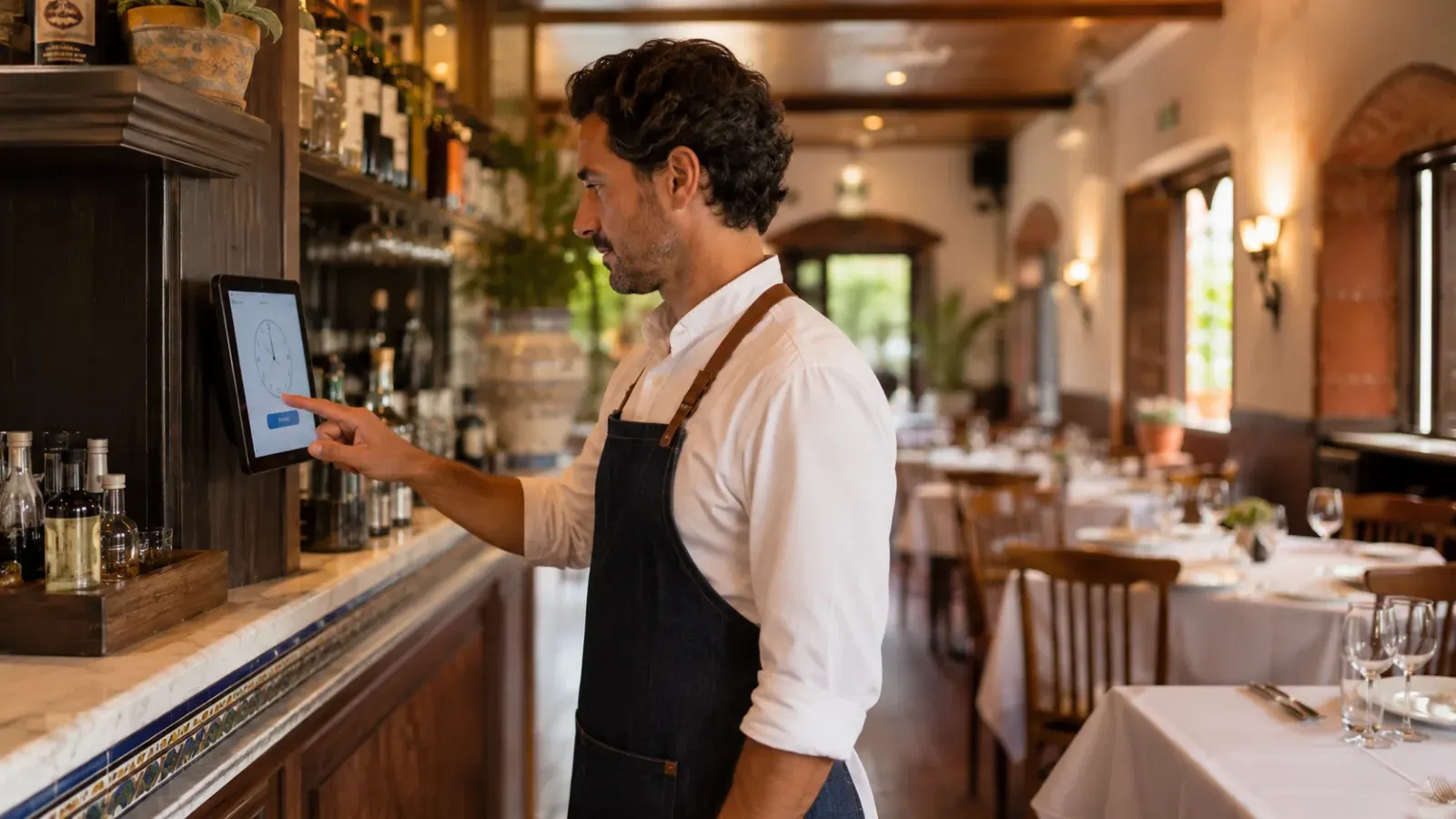
Plattio's digital time clock for restaurants is designed for the real operations of a restaurant, not for an office. The team clocks in, out, or on break in seconds from a phone, a tablet, or the venue's PC, with the option to enable personal devices or restrict clocking in to fixed kiosks. Every punch is stored with a timestamp and audit trail, so the history is complete and verifiable.
On that foundation, the system does the work that on paper piles up until month-end: shift, break, and overtime rules configurable by team, role, or venue; real-time alerts for late arrivals, absences, and overtime; automatic overtime calculation; and per-employee reports ready for payroll, exportable in common formats whenever you need them, including when it's your gestoría asking.
The connection with the rest of the operation is what keeps compliance from being an island: the team's time and attendance lives in the same system that manages the dining room, and whoever controls Saturday's shifts is looking at the same screen. If that's your bottleneck, complement this guide with the one on organizing operations at peak hour.
Practical summary
- Daily working time records have been mandatory since 2019 for every restaurant in Spain with employees, with no headcount threshold.
- They must reflect real hours, be kept for 4 years, and be producible at the venue immediately.
- The current fine is 751 to 7,500 euros per company; the 10,000 euros per worker is not in force.
- The digital clock-in royal decree is still in the approval process as of July 2026: approval announced, date and deadlines unconfirmed.
- The draft will require a digital medium, hour and minute, recorded breaks, unalterable entries, and remote Labour Inspectorate access.
- In hospitality, the hot spots are split shifts, part-timers, extras, mise en place, and the close.
- Setting the system up well once, with written rules and an incident protocol, costs less than reconstructing working days during an inspection.
Get your time records running before the royal decree lands
The advantage of sorting out clocking in now isn't just avoiding a fine: it's that when digital records become mandatory, your restaurant will already be compliant, with the team used to the system and shift data feeding the same platform you manage the dining room with.
About the author
Carlos Bergara
Operations and reservations specialist for restaurants
Carlos Bergara writes about operations, reservations, and analytics for restaurants on the Plattio blog. His articles draw on patterns the team observes in reservation management, waitlists, orders, and service metrics, applying operational judgment to front-of-house decision-making.
Frequently asked questions
Is a working time record mandatory in a small bar or restaurant in Spain?
Yes. The daily working time record obligation applies to every company with salaried employees, with no headcount threshold: a bar with two waiters is just as bound as a chain. Only self-employed owners without employees and a few special cases such as senior executives fall outside it.
Is digital clock-in already mandatory in Spanish hospitality?
No. As of the last review of this guide (July 9, 2026), the royal decree that will impose digital records is still in the approval process and has not been published in the BOE (Official State Gazette). What has been mandatory since May 2019 is recording every worker's hours daily, and today that record can be kept on paper, in a spreadsheet, or in a digital system, as long as it is objective, reliable, and unalterable.
When does the mandatory digital working time record come into force?
There is no confirmed date. As of July 9, 2026, the royal decree has not been published in the BOE; the Government has announced its approval before August 2026, and the draft provided for entry into force 20 days after publication, a period the Consejo de Estado (Council of State) called manifestly insufficient and that could be extended, especially for SMEs. Until then, the 2019 working time record remains in force, and it allows any reliable medium.
What is the fine for not keeping working time records?
Not keeping a working time record is a serious infringement, currently penalized with fines of 751 to 7,500 euros depending on the degree, assessed per company or workplace. The figure of up to 10,000 euros per worker that circulates on many blogs belonged to the working time reduction bill that Spain's Congress rejected in September 2025 and is not in force.
How do you clock a split shift in a restaurant?
With four punches: clocking in and out of the first service, and in and out of the second. If only the first clock-in and the last clock-out are recorded, the hours of the split-shift break would show up as worked, and a record that doesn't reflect real working hours is considered unreliable, which is equivalent to keeping no record at all.
What happens if a waiter forgets to clock in?
A missed punch doesn't invalidate the record if it's corrected properly: with a request from the worker, validation by the manager, and a trace of the change, never by editing the original entry without leaving a trail. What does compromise the restaurant is a pattern of incomplete working days with no correction protocol, because it turns the record into an unreliable one.
Do you have to record the hours of an extra who only works one weekend?
Yes. The obligation exists from day one and from the first worker, even if the contract lasts a single weekend. In addition, Social Security registration must happen before work starts, and if they work overtime it must be recorded, paid or compensated, and included in Social Security contributions.
What happens if a part-time waiter has no working time record?
The risk is double. Beyond the fine, the Estatuto de los Trabajadores (Workers' Statute) establishes that without a record, a part-time contract is presumed to be full-time unless proven otherwise, which can force you to regularize wages and Social Security contributions retroactively. It's one of the points the Labour Inspectorate checks most closely in hospitality.
How long do working time records have to be kept?
They are kept for 4 years, available to workers, their legal representatives, and the Labour Inspectorate. Part-time contracts carry an added obligation: giving the worker a copy of the monthly summary of hours along with the payslip every month and keeping those summaries for a minimum of 4 years as well.
Can the Labour Inspectorate demand the records without notice?
Yes. Inspectors can enter the premises unannounced, identify who is working at that moment, cross-check them against Social Security registrations, and demand the working time record, which must be producible immediately at the workplace itself, not sent over days later by your payroll firm.
Does an Excel sheet or paper count as a valid time record?
Today yes, as long as it reflects the real start and end time of each working day, can't be altered without leaving a trace, and is accessible at the venue. In practice, paper and Excel are easy to challenge because they can be filled in after the fact. The draft of the new royal decree plans to eliminate paper and require digital means, with the exception provided for domestic employment.
Is it legal to clock in with a fingerprint in a restaurant?
In practice, no. Fingerprints and facial recognition are special-category biometric data and, under the criteria held by the AEPD (Spain's data protection authority) since November 2023, there is currently no rule with the rank of law in Spain that authorizes their use for clocking in at work; the worker's consent doesn't legitimize it either. The Agency has already imposed fines of up to 365,000 euros for biometric clock-in without the required safeguards. The safe route is clocking in with a code, card, app, or kiosk, and if geolocation is used, limiting it to the moment of the punch and informing the team.
Do you have to clock the mise en place and closing the venue?
Yes. Setting up before opening and the closing and cleaning tasks after the last guest are working time and must sit inside the record. Clocking in when you open the doors to the public and out when you close the till, instead of when you start and stop working, produces a record that doesn't reflect real hours and creates a presumption of undeclared hours.
Do staff meal breaks get clocked?
It depends on how they're regulated. If the applicable hospitality collective agreement defines the break as effective working time, it counts and doesn't need to be clocked separately. If it doesn't count, like staff meals outside service or the split-shift break, the prudent move is to record its start and end; the draft of the new royal decree plans to make that mandatory, to the hour and minute.
What will change when the new royal decree on working time records is approved?
Records will have to be kept by digital means, reflect the hour and minute each working day and each non-countable break starts and ends, identify whether hours are ordinary, overtime, or complementary, guarantee that no entry is modified without leaving a trail, and allow the Labour Inspectorate remote access. The penalties, on the other hand, don't change with the royal decree: they will remain those of the current LISOS until another law is passed.
Keep exploring the cluster
Related articles
Operations
When is VeriFactu mandatory? Current dates and announced postponement
VeriFactu dates for companies, the self-employed and restaurants in Spain. What the BOE requires today, what Hacienda has announced for October 2028 and what still needs approval.
Operations
What a restaurant in Spain can legally charge you for (and what it can't): bread, cover charge, terrace, deposits, cards and doggy bags
A guide checked against the BOE and the regional consumer authorities: bread, a terrace surcharge and a booking deposit can be charged when the menu prices them before you order. A card surcharge and a doggy bag cannot, and the cover charge changes with the region.
Operations
VeriFactu in Spanish hospitality: what it requires of a bar or restaurant POS and how to get it ready
A guide, verified against the BOE, to what VeriFactu requires of a bar or restaurant POS, scene by scene. It covers the receipt, swapping it for an invoice, cancellations, and the till close, with the fines at stake and the steps to get your venue ready. The dates and the status of the postponement have their own article.