
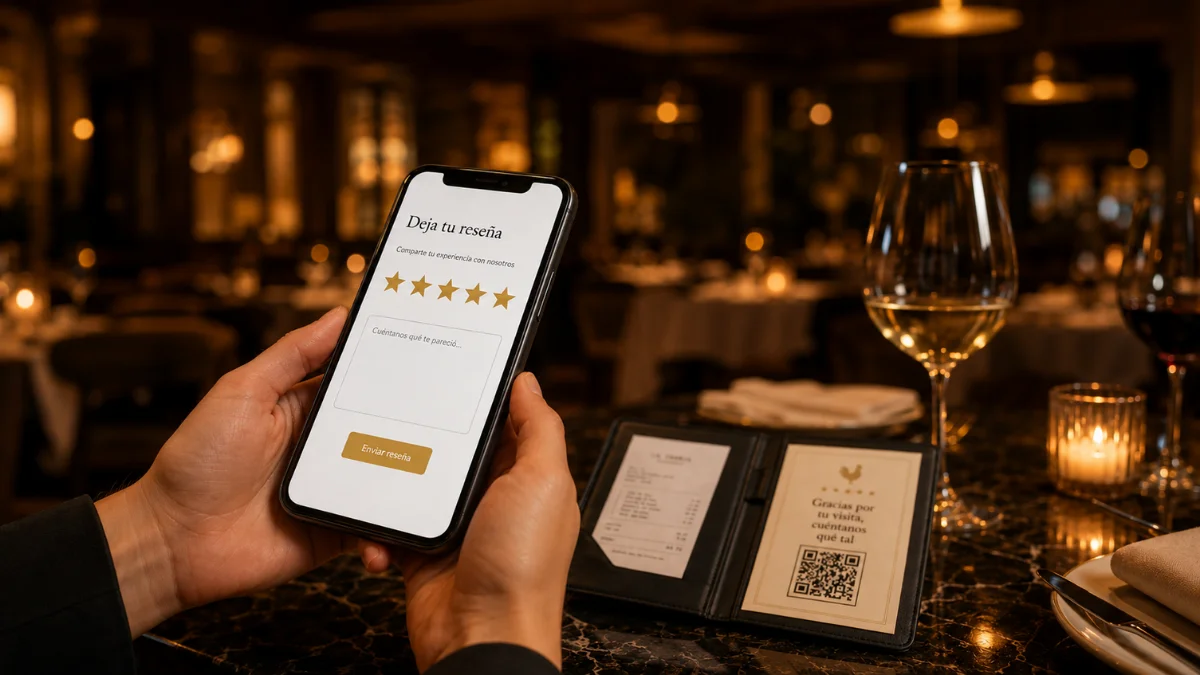
Practical guide
Getting more Google reviews for a restaurant doesn't come down to luck or to waiting for the guest to remember. It comes down to asking well, at the right moment, without friction, and consistently, and to responding to what arrives as if your next guest were reading it, because that's usually exactly the case.
Short answer: you get more reviews when you have a complete Google listing, ask for the review with the bill and in person, remove intermediate steps with a direct QR code, respond to every review starting with the negative ones, and turn that request into a measurable system. The payment moment, used well, is the lever that generates the most reviews.
In 60 seconds
How to get more Google reviews for your restaurant:
- Claim and complete your Google Business Profile.
- Ask for the review with the bill, in person, after a good experience.
- Remove friction with a QR code on the bill holder, on the table, and at the checkout area.
- Pair the QR code with a natural sentence; never leave it passive.
- Respond to every review, with priority on the negative ones.
- Capture feedback from everyone and handle anyone who had a problem privately.
- Automate the request after the visit and measure rating, volume, and recency.
Reviews have stopped being just about reputation. Today they're one of the signals that most influence whether a guest walks into your restaurant or keeps comparing, and also whether an AI recommends it when someone asks "where to eat well nearby." The usual problem isn't that the restaurant has bad reviews: it's that it has few, old, and unanswered ones, while the place next door racks up recent reviews every week.
At Plattio we work with restaurants that manage reservations, reviews, CRM, and operations from a single system. That experience lets us see a recurring pattern: the restaurant that asks for the review at the right moment and with a clear process generates a steady flow, while the one that leaves it to the guest's initiative depends on isolated spikes that don't sustain its reputation over time.
How this guide was created
This guide combines online reputation best practices with patterns we observe when connecting reservations, automated reviews, and analytics in Plattio. We don't give universal figures for "how many reviews you need" or promises of an exact rating increase, because that changes by area, category, average ticket, competition, and guest volume.
The right approach is more useful than a falsely precise figure: define a process to ask, respond, and measure, compare it against your own history and against the venues around you, and adjust it. The asking and responding part can be started today with no software cost. The real cost appears when you want to automate the request, capture feedback from every visit, and measure results without manual review.
Why reviews decide more today than ever
Reviews used to be a complement to reputation. Today they're one of the first decision filters. A guest who discovers you on Google rarely books without checking the rating, the photos, and, above all, what other people who have already been say. According to BrightLocal's Local Consumer Review Survey, around nine out of ten consumers read reviews before choosing a local business, and restaurants are among the most reviewed categories (source).
This has intensified for three reasons:
- Local ranking. Google orders map results and nearby searches by three factors: relevance, distance, and prominence. Reviews feed that prominence, so more reviews, better and more recent, help you appear higher when someone searches for a restaurant "near me" (source: Google).
- AI search. Assistants and the answers generated in search engines rely on public signals to recommend. Reviews are one of the clearest sources an AI can cite when suggesting a restaurant: their quantity, their score, their freshness, and what guests write.
- Trust before booking. Even if you're already on the guest's radar, recent, well-answered reviews are the final confirmation that tips the decision toward your venue instead of the one next door.
Put another way: reviews don't just convince the person who is already on your listing. They also determine whether you show up in the conversation when the guest doesn't yet know you exist and asks Google or an AI.
Reviews are, in addition, the final confirmation of the experience before the visit. If you want to see how they fit into the whole journey the guest takes before booking, this guide is complementary to the one on customer experience from the reservation onward.
The four components of a good reputation
"Having good reviews" isn't a single thing. It's four signals that are read together, and neglecting one makes the others pay off less.
| Component | What it measures | Why it matters | Common mistake |
|---|---|---|---|
| Average rating | The venue's overall score | It's the first number the guest sees | Obsessing over the decimal and forgetting the rest |
| Volume | How many reviews you have | Gives credibility to the average rating | Few reviews make any rating fragile |
| Recency | How recent they are | Confirms you're still good today | Good reviews, but all old |
| Response | Whether the restaurant replies | Shows attentiveness and reinforces prominence | Responding only to the good ones or to none |
The practical conclusion is clear: don't chase a decimal in the average rating. Chase a steady flow of recent reviews, with enough volume and visible responses. That combination conveys more trust than a 4.9 held up by reviews from two years ago. In fact, according to BrightLocal, 74% of consumers only take into account reviews published in the last three months (source), so a reputation that doesn't renew itself ages fast.
Step 1. Prepare the listing before asking for reviews
Asking for reviews on an incomplete listing is wasting requests. Before pushing traffic toward your profile, check that the foundation is solid. Your Google listing, officially the Google Business Profile (formerly Google My Business), is where reviews are published and where the guest decides in seconds whether to trust you.
Check that your Google Business Profile has:
- a correct name, address, and phone number, consistent with your website;
- up-to-date hours, including holidays and closures;
- recent photos of the venue, the dishes, and the atmosphere;
- a visible menu and reservation link;
- the right business category assigned;
- and, above all, a "write a review" button that works well from a phone.
If you manage the information across several channels at once, keeping it consistent is hard. With a website you edit yourself, which links your digital menu and takes bookings, you can fix a detail on your website the same day you change it on Google, which lowers the risk of the guest finding different details in the two places, an inconsistency that cools trust right before booking or reviewing.
Step 2. Ask for the review with the bill and in person
The "when" and the "who" weigh as much as the "how." The moment of highest conversion is when the guest asks for or pays the bill, after a good experience, and the request comes from a member of the team. Three things line up there: the memory is fresh, the guest is available for a moment, and the invitation feels personal rather than automated.
That same moment produces the most negative reviews when the bill carries an item the guest never saw on the menu. Before asking for the review, it pays to know what a restaurant can legally charge you for and to advertise it where it belongs.
In order of effectiveness, these are the moments to ask for the review:
- With the bill or when paying at the register, in person. It's the highest-converting one. A short sentence from the team when handing over the bill holder converts far better than any other route.
- At the goodbye, if there wasn't a clear payment moment at the table.
- Shortly after the visit, with an automated message that acts as reinforcement, not as a substitute.
The team's sentence matters more than it seems. A passive sign isn't the same as a human invitation: "If you've had a good time, a Google review helps us a lot, here's the QR code." Asking for it naturally, without pressure and at the payment moment, converts much better than waiting for the guest to do it on their own.
There's a direct connection here with repeat visits: the guest who comes back is also the one who leaves the best review. If you want to work on that second visit in parallel, this guide pairs with the one on how to get a guest to come back to your restaurant.
Step 3. Remove the friction: the QR code on the bill, on the table, and at the register
Every step between the intention and the published review loses guests. Searching for the venue, logging in, finding the right button: each piece of friction reduces conversion. A well-placed QR code solves almost everything, as long as it opens the write-a-review screen directly and not a generic search.
The supports that work best, in the order the guest encounters them:
- The bill holder or check presenter. It's the star support, because it arrives right at the payment moment. A nice big, visible QR code, alongside a sentence like "Thanks for your visit, tell us how it went," makes the most of the instant of peak conversion, especially if the server hands it over and mentions it kindly.
- A stand or display on the table. An acrylic holder with a clear message, for example "Tell us about your experience," keeps the invitation visible throughout the meal and supports the team's request.
- The checkout area or the register, if people pay at the bar. In formats where the guest pays standing up, a holder with the QR code at that point captures the review at the very moment of payment.
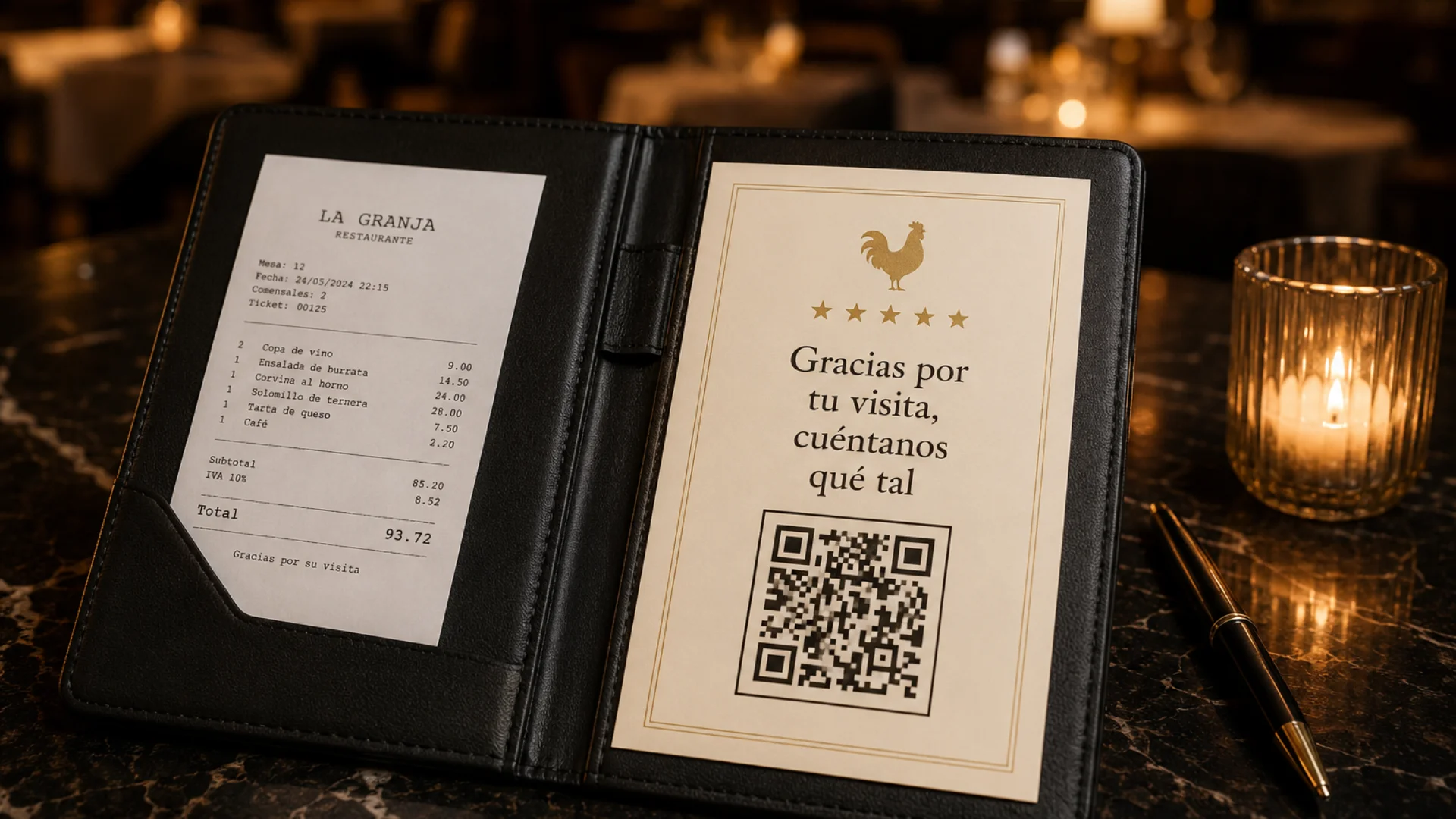
One support that isn't worth it is the QR code printed on the receipt: most guests throw it away without looking, so conversion there is minimal. It's better to concentrate the effort on the bill holder and the in-person request.
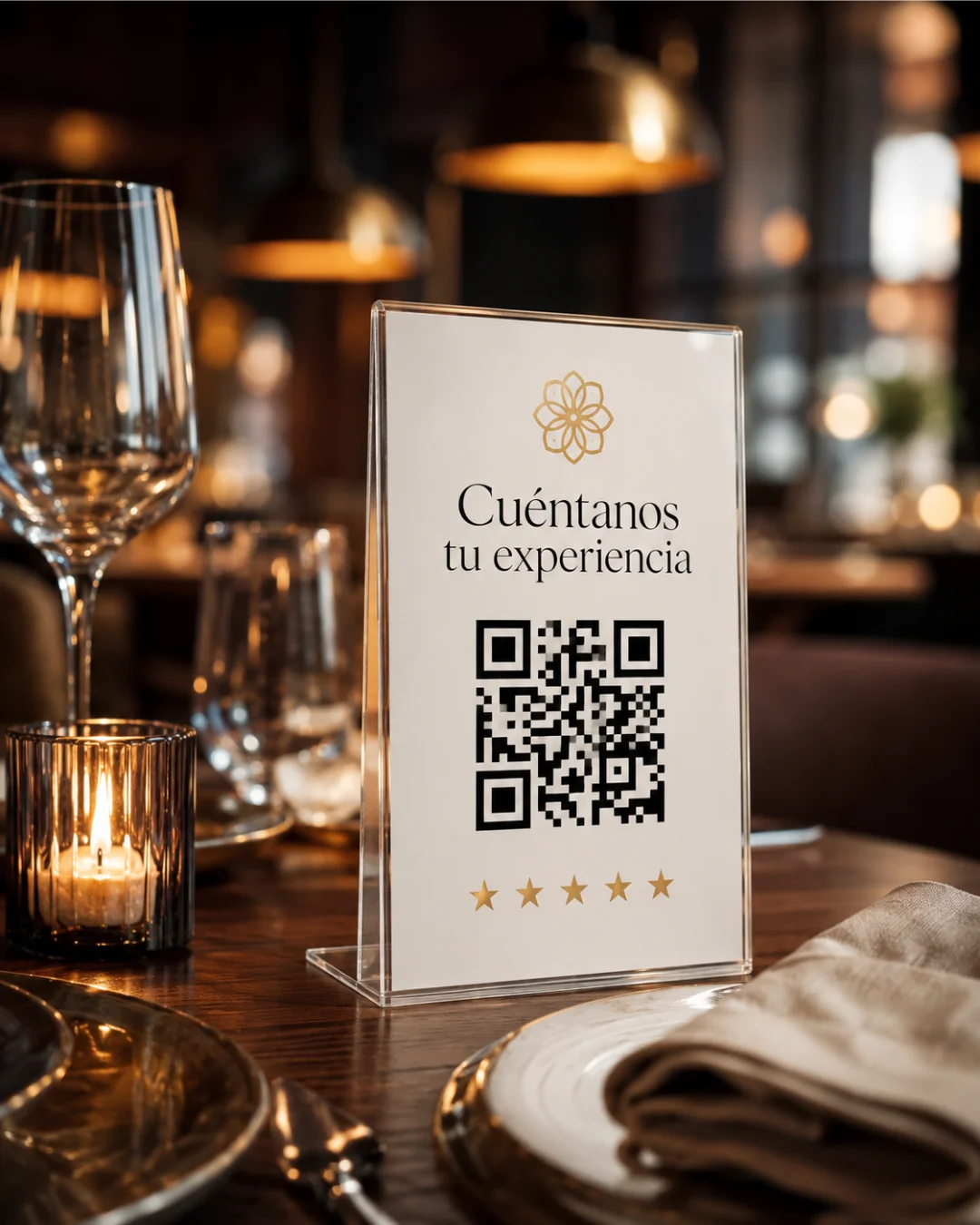
One recommendation that makes the difference: the QR code should never be left passive. A code on the table that no one mentions pays off little. The same code presented by the team when handing over the bill converts much more. The support accompanies; the person converts.
Step 4. Respond to every review (and start with the negative ones)
Responding to reviews isn't courtesy: it's part of customer acquisition and it reinforces your prominence with Google. The response is read above all by future guests who are deciding whether to book, not just by the person who wrote it. In fact, according to BrightLocal, 80% of consumers are more likely to use a business that responds to all of its reviews, while 42% avoid businesses that never respond (source).
The priority rule is simple: respond quickly to the negative ones, respond to the positive ones too, and don't let the ones that mention a specific problem slip by. How you respond changes depending on the type of review.
| Type of review | Goal | What to include | What to avoid |
|---|---|---|---|
| Positive | Reinforce the relationship and invite them back | A personal thank-you and a specific detail from their comment | Copying and pasting the same response to everyone |
| Legitimate negative | Contain the damage and show that you're handling it | Acknowledgment, a brief explanation, and a way to get in touch | Arguing, over-justifying, or blaming the guest |
| Unfair or fake | Show the real version to whoever is reading | A calm tone, facts, and, if appropriate, a report to the platform | Accusations or aggressive responses in public |
| Stars only, no text | Maintain presence and warmth | A brief, friendly thank-you | Asking for explanations or sounding pushy |
Response templates you can adapt
Don't copy them word for word: personalize them with the name and a detail from the visit. They work as a starting point.
5-star review:
"Thank you, NAME! We're so glad you enjoyed DETAIL THEY MENTIONED. We look forward to seeing you soon at RESTAURANT."
Legitimate negative review:
"Thanks for letting us know, NAME. We're sorry that SPECIFIC ISSUE wasn't up to standard. It's not the norm and we want to understand what happened: write to us at CONTACT and we'll sort it out. Thank you for giving us the chance to improve."
Review that looks fake or doesn't correspond to a real visit:
"Hi, we can't find any reservation or visit matching these details and we'd like to clear it up. If you've been with us, write to us at CONTACT and we'll be glad to look into it. We take care of every service and want to understand what happened."
A calm response to a difficult criticism usually conveys more professionalism than ten responses to perfect reviews.
Step 5. Turn it into a system, not a one-off campaign
Most restaurants ask for reviews in fits and starts: one week they remember, three they don't. That way reputation rises and falls without control. The leap in quality comes when the request stops depending on the team's memory and becomes a process that triggers with every visit.
A mature review system does three things that a manual process can't sustain:
- It asks at the right moment. The request is sent when the reservation closes or after the visit, without anyone having to remember, and it reinforces the in-person request at payment.
- It captures feedback from everyone. It gathers each guest's opinion, guides those who were satisfied toward the public review, and offers anyone who had a problem a private way to resolve it before it goes cold.
- It measures the result. How many open the link, how many leave a review, what rating and what recency, and how it evolves by location, shift, and team.
This is where the product comes in. A reviews tool for restaurants lets you send the request automatically when the reservation closes, capture in-house reviews with a QR code, launch a WhatsApp broadcast to recover reviews, and direct each star to the destination you prefer, all without turning it into a manual task for the team. The highest reviews are routed to your public profile, and the feedback from anyone who wasn't entirely happy reaches a private channel where you can ask for contact and make it up to them.
Automate the request and capture feedback from every visit. View Reviews.
Mistakes that cost you reviews
Some habits make the strategy exist but not pay off. These are the ones that cost the most:
- Leaving the QR code passive, on the table, with no one mentioning it.
- Asking for the review too late, when the guest has already left and the memory has cooled.
- Buying reviews or using fake accounts. They get detected, removed, and destroy your credibility when they come to light.
- Responding in the heat of the moment to a criticism. An aggressive response does more damage than the original review.
- Ignoring the negative ones. Silence reads as a lack of management.
- Not measuring anything and, therefore, not knowing which part of the process is failing.
Technology doesn't fix a bad process. First there has to be a clear routine of asking, capturing, and responding; only then does it make sense to automate it.
How to measure whether your review strategy works
Asking for reviews without measuring is working blind. These are the metrics worth reviewing periodically, ideally comparing against your own history and against the venues in your area.
| Metric | What it measures | If it worsens, what to review |
|---|---|---|
| New reviews per week | The real pace of acquisition | The moment of the request and the link's friction |
| Click rate on the request | How many open the link you send | Channel, message, and timing of the send |
| Average recency | How fresh your reputation is | Consistency of the request after each visit |
| Response rate | What percentage of reviews you answer | Who responds and how often they do it |
| Sentiment by topic | What keeps coming up: service, wait, kitchen, price | The operational problem behind the pattern |
The most underrated metric is the last one. Reviews don't just measure reputation: they're a source of operational diagnosis. If several reviews repeat "we waited a long time," the problem isn't marketing, it's front-of-house, and it connects with how you organize operations at peak hour. AI sentiment analysis helps classify that volume without reading review by review, so the pattern stands out sooner.
If you want to fold the reading of reviews into a broader business routine, alongside coverage, repeat visits, and channel, it fits with these growth metrics for restaurants, and to cross-reference reviews with repeat visits and time slot you lean on a CRM with analytics for restaurants.
Reviews and demand: a signal that gets ahead of the register
A slowdown in the pace of reviews or a change in their tone usually appears before a clear drop in reservations. That's why it's worth looking at them as part of the set of demand signals for your restaurant, not as an isolated indicator of reputation.
The trust that reviews generate also has an upstream effect: a guest who sees recent, well-managed reviews hesitates less before booking and, in part, has less incentive to not show up. It's one of the soft levers that accompany the more direct work of reducing no-shows.
Checklist to activate your review strategy this week
- Claim and complete your Google Business Profile.
- Create the direct "write a review" link and generate the QR code.
- Place the QR code on the bill holder, on a table stand, and at the checkout area.
- Agree with the team on the sentence to ask for the review at payment.
- Activate the automatic send of the request after the visit.
- Define who responds and within what timeframe.
- Prepare templates for positive, negative, and questionable reviews.
- Start measuring new reviews, recency, and response rate.
- Review sentiment by topic every week.
- Capture feedback from everyone and handle anyone who had a problem privately.
This checklist doesn't require major technical changes to get started. It requires consistency. A simple but consistent review strategy beats an excellent one that only kicks in once in a while.
How Plattio fits into this flow
At Plattio, reviews aren't an isolated tool: they gain value when they connect with reservations, CRM, and operations. The request can trigger automatically when the reservation closes, be captured in-house with a QR code, or be sent via WhatsApp broadcast when you want to recover volume. Each star can be directed to the destination you prefer, and the panel shows performance by location, shift, and team, with click-per-link metrics and AI sentiment analysis on every review.
The goal isn't to "have another screen." It's to close the loop: the guest books, lives the experience, receives the request at the right moment, leaves the review without friction, and you respond and measure. When the reservation and the review live in the same flow, asking for reviews stops being a task that gets forgotten and becomes a natural consequence of every service.
Practical summary
Getting more Google reviews isn't a matter of luck or of asking more loudly. It's a matter of process:
- prepare a complete, consistent listing;
- ask with the bill and in person, not days later;
- remove the friction with a QR code on the bill holder, the table, and the checkout area;
- respond to every review, with priority on the negative ones;
- automate the request, capture feedback from everyone, and measure it;
- and work on your reputation continuously, not in fits and starts.
If your restaurant already delivers good experiences but it doesn't show on Google, almost always the problem isn't the kitchen: it's that you're not asking well or at the right moment. That's where a review system changes the outcome.
Turn every good visit into a review that brings in guests
When the reservation, the review, and the response live in the same system, no longer losing reviews stops depending on the team's memory. Plattio lets you ask for the review at the right moment, direct each star to its destination, respond with context, and measure rating, recency, and sentiment from a single panel.
About the author
Cristina Fattucelli
Marketing specialist for restaurants
Cristina Fattucelli writes about marketing, customer acquisition, and digital reputation for restaurants on the Plattio blog. Her articles draw on patterns the team observes across reservations, reviews, conversion, repeat visits, and online visibility, with a focus on how to turn that information into clearer commercial actions.
Frequently asked questions
How do you get more Google reviews for a restaurant?
The most effective way is to ask for the review with the bill and in person, remove all friction with a QR code that opens the write-a-review screen directly, and turn that request into a system that triggers after every visit. Asking well and at the right moment brings in far more reviews than waiting for the guest to do it on their own initiative.
What is the best moment to ask a guest for a review?
The moment of highest conversion is when the guest asks for or pays the bill, right after a good experience and always in person. At that instant the memory is fresh and the team's request feels personal. An automatic message shortly after the visit works as a reinforcement, not as a substitute for that in-person request.
Where do I place the QR code to ask for reviews in a restaurant?
The supports that work best are the bill holder or check presenter, a stand or display on the table, and a holder at the checkout area when people pay at the bar. Avoid relying on the printed receipt, because most guests throw it away without looking at it. The key is for the QR code to open the write-a-review screen directly, not a generic search, and for the team to mention it when handing over the bill rather than leaving it passive on the table.
Is it legal to ask restaurant guests for reviews?
Yes, asking for reviews and inviting people to share their opinion is legitimate and advisable. What you should avoid is posting fake or bought reviews, because the platforms detect them, remove them, and they damage your credibility. The solid approach is to make the process easy, capture feedback from every guest, and direct anyone who had a problem to a private channel to resolve it.
How do you respond to a negative review in a restaurant?
Respond quickly, without arguing, and from a place of acknowledgment. Thank the person for their comment, accept whatever is true, explain briefly without long excuses, and offer a private way to get in touch and resolve it. Remember that the response is read above all by future guests, so the tone matters as much as the substance.
What do I do with a fake or unfair review?
First respond politely and with facts, without getting into conflict, because other guests will read that response. If the review breaches the platform's policies (it's fake, offensive, or doesn't correspond to a real guest), you can report it for review. It isn't always removed, which is why a good public response usually protects you more than the complaint itself.
What do I do with a guest who wasn't satisfied?
The most worthwhile thing is to capture that feedback privately before it goes cold and offer them a way to tell you what happened so you can make it up to them. Resolving a problem in time wins the guest back and stops a one-off bad moment from turning into a public criticism with no context. That service recovery protects your reputation better than any later response.
How many reviews does a restaurant need?
There's no single number that works for everyone. It matters more to keep a steady flow of recent reviews than to hit a specific figure and then stop. A restaurant with lots of reviews that are all old conveys less trust than one with fewer reviews that are recent and well answered. Compare your volume and recency with the venues in your area and category.
Does the average rating or the recency of the reviews matter more?
Both matter, but recency usually carries more weight than people think. A high rating held up by reviews from two years ago raises doubts, whereas recent reviews confirm that the experience is still good today. That's why it's worth generating reviews continuously and not just in one-off campaigns.
How do reviews affect a restaurant's local ranking?
Google orders local results by relevance, distance, and prominence, and reviews feed that prominence: their number, their score, and their freshness help your restaurant appear higher on the map and in nearby searches. Responding to reviews also reinforces that signal of activity and attentiveness.
Why do reviews influence whether AI recommends my restaurant?
AI assistants and the answers generated in search engines rely on public signals of trust, and reviews are one of the clearest: volume, rating, recency, and the textual content of what guests write. If your restaurant has recent, consistent, well-answered reviews, it's easier for it to come up when someone asks an AI for a recommendation.
How often should I respond to reviews?
The ideal is to respond continuously, not to pile them up and reply once a month. Speed on the negative ones reduces the damage, and responding to the positive ones too reinforces the relationship and encourages others to share their opinion. If you struggle to keep up the pace, always prioritize the negative ones and the ones that mention specific problems.
Keep exploring the cluster
Related articles
Experience
Customer experience at your restaurant: it starts before the visit
What a guest sees, compares, and hesitates over before booking your restaurant. Learn how to improve your website, reservation flow, reviews, and pre-visit trust.
Operations
When is VeriFactu mandatory? Current dates and announced postponement
VeriFactu dates for companies, the self-employed and restaurants in Spain. What the BOE requires today, what Hacienda has announced for October 2028 and what still needs approval.
Operations
What a restaurant in Spain can legally charge you for (and what it can't): bread, cover charge, terrace, deposits, cards and doggy bags
A guide checked against the BOE and the regional consumer authorities: bread, a terrace surcharge and a booking deposit can be charged when the menu prices them before you order. A card surcharge and a doggy bag cannot, and the cover charge changes with the region.