
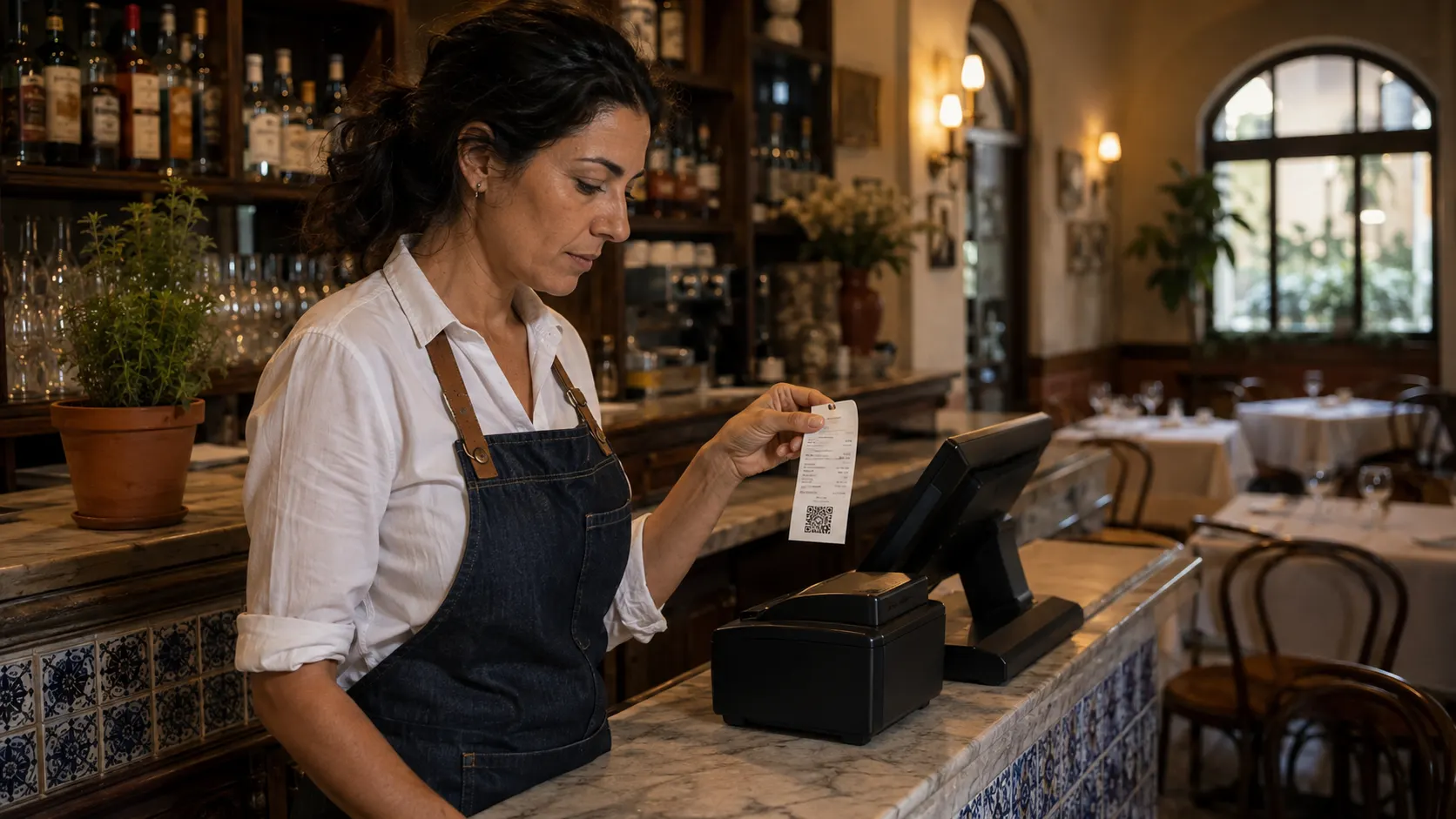
Practical guide
VeriFactu has suffered the worst fate a rule can suffer: changing its date twice while half the internet never updated. Some blogs insist it is already mandatory, POS websites say 2027 in the headline and 2026 in their own FAQs, and restaurant owner groups juggle three different calendars at once. This guide pins the dates against the BOE (Official State Gazette), explains what the regulation demands of a bar's till, and translates it into scenes you know: the coffee at the bar, the table asking for an invoice, the till close in the small hours.
Short answer: as of August 16, 2026, VeriFactu is not yet mandatory for any bar or restaurant. Royal Decree-Law 15/2025 (Real Decreto-ley 15/2025, BOE of December 3, 2025) postponed the obligation: companies must have their invoicing system adapted before January 1, 2027, and the self-employed before July 1, 2027. The one already bound since July 29, 2025 is your POS provider, who can only sell you adapted software. And in the Basque Country VeriFactu does not apply: TicketBAI rules there, and it is in force.
In 60 seconds
VeriFactu in Spanish hospitality, the essentials:
- It is not yet in force for businesses: companies before January 1, 2027, the self-employed before July 1, 2027 (Royal Decree-Law 15/2025).
- The 2026 dates circulating online belong to an earlier calendar (RD 254/2025), replaced before it ever applied.
- The obligation falls on the software rather than the hardware: the POS must generate chained records that cannot be erased, with a tax QR code on every receipt.
- Since July 29, 2025, any invoicing software sold must already be adapted. Ask for the compliance declaration.
- There is no list of POS systems approved by the Spanish tax agency (AEAT): the model relies on the manufacturer's own compliance declaration.
- The €50,000 fine per financial year punishes a specific case: a non-compliant system that also lacks the required certification, or is certified but altered. It arrives with the obligation; what has been punishable since 2021 is making or selling dual-use software, at €150,000 for the manufacturer or reseller per financial year with sales and type of system.
- The Basque Country and Navarre sit outside VeriFactu because of their regional (foral) regime: TicketBAI already applies in the Basque Country, and in Navarre there is no equivalent system in force today. The Canary Islands, Ceuta, and Melilla do fall under it.
At Plattio, the restaurant management software that brings reservations, orders, payment, and invoicing together in a single system, we see the same pattern as with working time records: the venue that adapts calmly in the low season spends an afternoon getting it in order; the one that waits until the last quarter ends up migrating its POS in the middle of the company dinner season.
How this guide was created
This guide rests on primary sources: Royal Decree-Law 15/2025, which sets the calendar in force, the consolidated text of Real Decreto 1007/2023 (the regulation on invoicing systems), Orden HAC/1177/2024, which lands the technical detail, the invoicing regulation (RD 1619/2012), the Batuz definitive implementation calendar for the Bizkaia dates, and the AEAT's official information note and FAQs, updated by the agency in March and July 2026.
Two honest caveats. First: Royal Decree-Law 15/2025 was ratified by Spain's Congress and is also being processed as a bill, so the text could still be retouched; that is why this guide dates every statement and will be updated if the calendar moves again. Second: this is an operational guide for restaurant operators, not tax advice; for your specific case (tax regime, activity headings, foral territory, open proceedings), talk to your tax advisor.
What you should take away from this article
- Certainty: the date that affects you, with the exact rule that sets it and why other sites say something different.
- Judgment: what really changes in a bar's till, from the QR on the receipt to cancellations that leave a trace.
- Process: how to get the venue ready during 2026, without waiting for December.
- Checklist: the exact questions to ask your POS provider, downloadable to bring to the meeting.
When does VeriFactu become mandatory for bars and restaurants? The real dates
Status of the calendar (last verified: August 16, 2026): the dates in force are those of Royal Decree-Law 15/2025, confirmed by the AEAT in its information note and its FAQs, updated in March and July 2026. No bar or restaurant in common territory is yet required to invoice under VeriFactu. This section is reviewed every week for as long as the calendar can still move.
Who | Deadline | What sets it |
|---|---|---|
Restaurants that are companies (SL, SA) | Before January 1, 2027 | RD-Law 15/2025 (BOE, December 3, 2025), which rewrites the fourth final provision of RD 1007/2023 |
Self-employed owners and other taxpayers (personal income tax with business activity, income attribution regimes) | Before July 1, 2027 | The same rule, confirmed by the AEAT's information note |
POS manufacturers and resellers | Since July 29, 2025 they can only offer adapted software | Fourth final provision of RD 1007/2023: nine months from the entry into force of Orden HAC/1177/2024. The postponement did not touch this deadline |
Restaurants in the SII (whether required or by voluntary opt-in) | Excluded from VeriFactu | The AEAT's official FAQ on scope: the SII and VeriFactu are mutually exclusive systems |
Tax domicile in the Basque Country or Navarre | Outside VeriFactu because of the regional (foral) regime: TicketBAI already applies in the Basque Country; in Navarre there is no equivalent system in force today | The AEAT's official FAQ. The Canary Islands, Ceuta, and Melilla do fall under the state system |
The practical rule for finding your date: look at how the business pays tax rather than at its size. If the restaurant is an SL, it files corporate income tax and its deadline is January 1, 2027. If you are self-employed, you pay personal income tax (IRPF) and your deadline is July 1, 2027; the same date applies to comunidades de bienes and other income-attribution entities. Capacity, headcount, and revenue do not change the date, with one exception: businesses in the SII (Spain's real-time VAT reporting system), whether required to be or by voluntary opt-in, sit outside VeriFactu entirely.
If you read "January 2026" somewhere else: the chain of postponements
A good share of Google's first page still tells a repealed calendar, and it is easy to see why: there have been two postponements in eight months. The full chronology, verifiable rule by rule:
- October 11, 2021. Spain's anti-fraud law, Ley 11/2021, comes into force: invoicing systems must guarantee the integrity and inalterability of their records (article 29.2.j of the Ley General Tributaria, Spain's General Tax Law), and article 201 bis is born, which penalizes dual-use software. This has applied ever since, without waiting for VeriFactu.
- December 6, 2023. Real Decreto 1007/2023 publishes the regulation on computerized invoicing systems, with a first planned date in July 2025.
- October 28, 2024. Orden HAC/1177/2024 pins down the technical detail. Its entry into force starts the manufacturers' nine-month clock.
- April 2, 2025. RD 254/2025 moves the dates to January and July 2026. This is the calendar many blogs and the odd POS website still repeat.
- July 29, 2025. The manufacturers' deadline expires: from this day on they can only offer software adapted to the regulation.
- December 3, 2025. Royal Decree-Law 15/2025 sets the calendar in force: January 1, 2027 for companies and July 1, 2027 for everyone else. Congress ratified it on December 11 and agreed to process it as a bill as well.
- March and July 2026. The AEAT updates its information note and its FAQs, confirming the 2027 dates and describing 2026 as an adaptation period with voluntary submission.
When a website gives you a VeriFactu date, check two things: whether it cites Royal Decree-Law 15/2025 and when it was last updated. If it does neither, distrust the whole calendar.
What VeriFactu is and what changes inside the POS
VeriFactu is the popular name for the regulation that governs computerized invoicing systems (SIF in the rule's jargon). The POS software of a bar issuing receipts is exactly that, so the regulation applies to it in full. What it demands, in plain English:
- A record for every receipt. Every time the system issues a receipt or an invoice, it generates at that same moment a record with the fiscal data of the operation: issuer, number and series, date, type, taxable base, VAT, and total amount, with the date, time, and time zone of generation.
- A chained hash. Each record carries a cryptographic hash calculated over its own data and over part of the previous record's hash. The chain makes it mathematically detectable if someone deletes receipts or slips them in after the fact.
- Nothing gets deleted. A receipt issued by mistake is not removed: its cancellation is recorded, with a trace. Errors in amounts or details are corrected with a corrective invoice. The system cannot allow deleting, renumbering, or rewriting anything already issued.
- A tax QR code on every receipt. Every receipt and every invoice coming out of the system carries, on paper or as a PDF, a QR code between 30x30 and 40x40 millimeters with the basic data of the operation (a structured electronic invoice carries it as a URL, without the graphic). It is mandatory in both modes, but it does not do the same thing in each: in VERI*FACTU, the customer who scans it checks the receipt against the records the AEAT already holds; in the retention mode there is nothing to check against, and scanning serves to put the invoice on record with the Agency.
- The ability to submit to the AEAT. The system must be able to send its records to the tax agency automatically and securely, whether it works in submission mode or the AEAT requires them.
VERI*FACTU or the retention mode: which suits a restaurant
The regulation allows two ways to comply, and the choice matters because it changes the technical burden on the venue:
Criterion | VERI*FACTU (submission to the AEAT) | Retention mode |
|---|---|---|
What happens to each receipt | The record is submitted to the AEAT at the moment, automatically | The record stays in the restaurant's system, under its custody |
Electronic signature | Not required: the chained hash is enough | Mandatory, with a qualified certificate |
Event log | Not required | Mandatory: start-ups, shutdowns, anomalies, exports, with periodic summaries |
Retention | The records submitted are not in your custody: they are already in the AEAT's hands. The invoices and the record books are kept just the same | The restaurant's responsibility for the whole limitation period, with a dump if the AEAT requires it |
The receipt | QR plus the VERI*FACTU legend, checkable by the customer on the portal | QR without the legend: the legend is reserved for those who actually submit |
Burden for a bar | Low: the system does it on its own and is presumed to meet the technical requirements of article 8 by design | High: signatures, event logs, and years of record custody; the only thing it avoids is automatic submission to the AEAT |
For almost any restaurant, the answer is VERI*FACTU. The classic argument against it, the venue's connectivity, is neutralized by the rule itself: if the internet drops you keep invoicing, the system queues the records and resends them with retries at least every hour.
Two nuances before switching anything on. The first is that testing does not tie you down. The rule says the mode is kept at least until December 31 of the year of the first effective submission, but the AEAT has clarified in its FAQs that this lock is not turned yet: until your own deadline you are in a trial period and you can stop submitting whenever you want. Careful with the word trial, because it does not mean rehearsal: the invoices you issue in those months are real invoices, with their QR code and their records genuinely submitted. The AEAT's pre-production environment, which genuinely does have no fiscal effect, is a different thing and it is meant for developers. The second nuance is that the VERI*FACTU legend on the receipt can only be displayed while you are genuinely submitting.
And a detail many comparisons skip: what VERI*FACTU saves you from keeping is the invoicing records already submitted, not the invoices. Keeping the invoices you issue and receive and the record books is still your obligation, as a general rule four years under tax law and six from the last entry under the Commercial Code. I say as a general rule because there are cases with longer periods, so that is the floor, not the ceiling.
The venue's day to day, scene by scene
Generic VeriFactu guides are written for accountancy firms. A restaurant has its own case book, and this is where it gets decided whether the adaptation hurts or goes unnoticed.
The coffee at the bar is a simplified invoice
The everyday receipt is, for the rule, a simplified invoice (type F2). Hospitality has an explicit privilege in the invoicing regulation: it can issue one for up to €3,000 including VAT, against the general limit of €400. VeriFactu does not change the type of document; what changes is that every receipt, even a €1.50 coffee, generates its chained-hash record at the moment it is issued.
The waiter charges the wrong amount
Charging table 4 twice, slipping a cola onto the wrong bill, closing with the wrong total: all of that will keep happening. What changes is the correction. The wrong receipt is not deleted: it is cancelled with a record that leaves a trace, and the amount is corrected with a corrective invoice. There is a third case that does not touch the invoice at all: if what is wrong is only the record —a badly transferred detail when the entry was generated, with the receipt itself fine—, the system issues an amendment record that corrects the previous one, with nothing cancelled or rectified. If your current POS fixes mistakes by making the receipt disappear, that gesture is exactly what the rule is after.
Comps and discounts
The comp for the regular and the lunchtime discount are not going away; what ends is applying them by reopening bills already closed. The clean practice is to record them as explicit lines before closing the bill, with their reason, and to review with your advisor how comps are treated for VAT. A closed bill is an issued record, and an issued record does not get touched up.
The company dinner asks for an invoice
If the recipient is a business and asks for one, they are entitled to a full invoice. With the receipt already printed, the swap does not mean deleting and reissuing: the receipt stays in the chain and the system issues a full invoice that replaces it, recorded under type F3. Two clarifications almost no guide gets right. Referencing the number, series, and date of the replaced receipt is advisable for traceability, but the AEAT treats it as optional, so a POS does not breach the rule by skipping it; what is mandatory in an F3 is identifying the recipient as on any full invoice: name or company name, tax ID (NIF), and address. And there is a route that saves the whole swap: if the table says so before the bill is closed, the receipt can be issued from the start with the customer's NIF, address, and itemized VAT amount, and it is born directly as an F1 record, with no swap to handle. Check that your POS handles both during service itself, because the whole of December consists of tables asking for an invoice at midnight.
The till close in the small hours
The Z report remains useful as an internal control: cash count, expected cash, mismatches. What stops existing is the close that cleans up. VeriFactu does not work on daily totals: the record is receipt by receipt, and a close that makes operations disappear turns the POS into dual-use software, banned since 2021. The correct order is to reconcile the Z against the system's records, never the other way around.
Terrace, card terminal, and pre-bill
VeriFactu records the issuing of the receipt rather than the payment: cash, card, or Bizum (Spain's mobile payment system) makes no difference, and the card terminal is not part of the invoicing system. The delicate point on the terrace is a different one: the pre-bill carried to the table is not an invoice, and the habit of charging on the proforma without ever issuing the final receipt runs out of room. The real receipt, with its QR, must come out of the system.
Delivery platforms
If you work with delivery platforms, who invoices the end customer depends on the contract: there are models where you invoice the platform and models where the platform invoices on your behalf, and in the latter case those records must comply with the regulation too. It is worth rereading the contract and checking that platform sales enter the system without duplicating the dining room receipts.
Tips
A genuinely voluntary tip, the one the customer decides to give and to quantify, is not consideration for the service: it stays outside the VAT base and, for that reason, does not go into the invoicing record. That is settled doctrine of the Dirección General de Tributos: ruling 2174-03, of 2003, settled it precisely for restaurant tips; V3095-17, of 2017, now binding, fixed the same criterion; and V1808-22, of 2022, reiterated it in a different case, voluntary contributions to a website. A charge imposed by the house is a different matter (cover charge, terrace supplement, "service included"): that is price, it goes on the receipt and is taxed like everything else. And from here on, an operational recommendation of ours, not a requirement of the regulation: if the tip comes in through the card terminal, do not put it on the receipt and track it in a separate internal control, so the till reconciles against the system's records. Its distribution and its treatment in payroll, with your advisor.
Do you have to change your POS for VeriFactu?
The million-euro question has a reassuring answer: the obligation falls on the software. The touchscreen, the cash drawer, the thermal printer, and the card terminal are not regulated; what must adapt is the program that issues the receipts. If your provider updates your version to a compliant one, you change nothing else.
The less reassuring part: since July 29, 2025, anyone selling you invoicing software can only sell it adapted, and no official certification exists to prove it. The Spanish model relies on a declaración responsable, a formal compliance declaration: the manufacturer declares, under its own responsibility and for each version, that the system meets the regulation, and that declaration must be visible inside the program itself. Two direct consequences. The sales line "approved by the AEAT" is a warning sign, because that approval does not exist. And the useful question for your provider is "show me the compliance declaration for the exact version I have installed", which gets you much further than "do you comply with VeriFactu?".
Signs your current POS is not going to make it to 2027: the provider gives no adaptation date and shows no compliance declaration, the system currently lets you delete or renumber issued receipts, it does not distinguish a cancellation from a deletion, it cannot issue a substitute invoice from a receipt, or the company has gone months without publishing an update. Each one alone is uncomfortable; together they sketch a forced migration in the worst possible quarter.
Self-employed with a bar: modules, paper receipt books, Excel, and the AEAT app
Four doubts concentrate half of all questions from the self-employed, and all four have short answers.
The modules regime does not exempt you. The VeriFactu obligation does not depend on your assessment regime: it reaches every self-employed person with a business activity who invoices with a computerized system, whether they pay tax under modules (estimación objetiva) or under direct assessment. Your date is July 1, 2027.
The paper receipt book is still valid. VeriFactu regulates computerized invoicing systems; it does not force you to buy one. The bar that issues every receipt by hand, from a receipt book, sits outside the regulation.
With Excel it depends on the use. Here the AEAT has put in writing where the line is drawn, and it is not where many people think. If the spreadsheet is used only to enter the invoice data, issue and print the invoices, and keep the information, including listings with totals and other calculation rules, the regulation does not affect you. It becomes a computerized invoicing system when you also use it to process that data and generate directly the VAT or personal income tax record books, the accounts, or any other output you use to meet tax obligations. The example the Agency itself gives is a macro that builds the record book of issued invoices. Once that line is crossed you do have a problem: a spreadsheet cannot sustain the chained hash or the inalterability, and it is time to change tools. For a bar, in any case, what decides the matter is almost never Excel: it is the POS the receipts come out of.
And the AEAT's free application is no use for the bar. It pays to know what it is for and what it is not. The Agency has a free invoicing application, but it requires identifying the recipient on every invoice and, because of that, it does not issue simplified invoices. It says so itself: "Every invoice must include a recipient, so it is not possible to issue simplified invoices (receipts)". It only allows full invoices, corrective invoices, and invoices substituting a simplified one. In a bar, where almost everything going through the till is a receipt, it is left for the occasional full invoice the company in the private room asks for. There is a second reason not to build the business on top of it: the records cannot be exported to another program, so if you start there and later switch, the history stays inside.
Penalties: exactly what is at stake
The penalty regime has two floors, and it pays to keep them apart.
The new floor is article 201 bis of the Ley General Tributaria, created by the 2021 anti-fraud law, and it pays to read it closely, because it does not punish "not complying with VeriFactu" in general. For the POS manufacturer or reseller: making or selling software that can hide sales, keep double books, or alter records already issued, or that does not meet the technical specifications, costs €150,000 per financial year with sales and per type of system, and selling uncertified systems when certification is due, €1,000 per unit. For the restaurant the offence is narrower than it is usually told: the fixed fine of €50,000 per financial year punishes running a system that does not meet what article 29.2.j of the Ley General Tributaria requires and that, on top of that, either is not duly certified when it should be, or is a certified system someone has altered. Under VeriFactu, certified means the manufacturer has issued the compliance declaration for that version. The timing nuance matters: the strand tied to the regulation will become enforceable when the obligation does, in 2027, but the ban on dual-use software has applied since October 2021. A POS that lets you delete sales today is already punishable without waiting for VeriFactu, but each party down its own route: the manufacturer that sells it faces article 201 bis, in force since 2021; the business that uses it to hide sales may face today, among others, the infringements of the classic floor.
The classic floor is article 201 of the Ley General Tributaria, the one already applied every day: failing to issue or keep receipts and invoices is a serious infringement with a proportional fine of 2% of the amount of the operations affected (€300 per operation when the amount is unknown), issuing them with incorrect data carries 1%, and invoices with false data, 75%. When the breach is substantial, the rule itself doubles the fine (paragraph 5 of article 201). This is the route used today to penalize a bar for not handing over a receipt, and it waits for no calendar.
VeriFactu is not B2B electronic invoicing or TicketBAI
Three different rules circulate mixed together in conversations, blogs, and even the odd POS website. Each one regulates a different thing and switches on at a different moment:
| VeriFactu | B2B electronic invoice | TicketBAI |
|---|---|---|---|
What it regulates | How the record of every receipt or invoice is generated and, depending on the mode, kept or submitted to the AEAT, so that it cannot be altered | How invoices travel between businesses and the self-employed, in electronic format | A function analogous to VeriFactu's, in a Basque foral version, with its own rules, requirements, and calendar, and submission to the foral tax authority |
Legal basis | RD 1007/2023 and Orden HAC/1177/2024 | Ley 18/2022 (Crea y Crece), implemented by RD 238/2026 (BOE of March 31, 2026) | Foral rules of Álava, Bizkaia, and Gipuzkoa (in Bizkaia, within Batuz) |
Who it applies to | Common territory, the Canary Islands, Ceuta, and Melilla included; the SII and foral territories stay out | Operations between businesses and the self-employed (B2B); the diner's ordinary receipt is not B2B | Businesses with their tax domicile in the Basque Country; Navarre is preparing its own foral system |
When | January 1, 2027 (companies) and July 1, 2027 (self-employed) | No firm date yet: the deadlines (12 months above €8 million in the prior year's volume of operations, 24 for everyone else) run from a ministerial order of technical specifications not yet published | Already mandatory for a bar: in Gipuzkoa since November 1, 2022, in Álava since December 1, 2022, and in Bizkaia (within Batuz) since January 1, 2025 for micro, small, and medium-sized companies (large ones, since January 1, 2024) and July 1, 2025 for the self-employed and income-attribution entities with no member paying corporate income tax or non-resident income tax through a permanent establishment (with one, since January 1, 2025) |
The most expensive confusion is the first column against the second: VeriFactu regulates how the receipt is born, and the B2B electronic invoicing of Royal Decree 238/2026 regulates how the invoice travels between businesses, in a structured format and with tracking of its acceptance and payment statuses. A restaurant will end up living with both, each at its own pace, and no serious provider will sell them to you as if they were the same thing. That the second one has no effective date yet does not mean it is not coming: it means its countdown starts when the ministerial order of technical specifications is published, and from there it will be 12 months for businesses above €8 million in the prior year's volume of operations and 24 for everyone else. The third column has its own foral source: the Bizkaia phases can be checked against the official Batuz implementation calendar.
How to get your restaurant ready during 2026, without waiting for December
The postponement to 2027 is a concrete opportunity: for the first time, the sector is ahead of the date. These are the seven steps, designed to be done calmly in the low season.
1. Find your deadline
Company, January 1, 2027; self-employed, July 1, 2027; tax domicile in the Basque Country or Navarre, outside VeriFactu because of the regional (foral) regime (TicketBAI already applies in the Basque Country; in Navarre there is no equivalent system in force today); in the SII (whether required or by voluntary opt-in), also outside. Write it down with margin: the company deadline falls right after the Christmas rush, the worst imaginable moment to break in a new POS.
2. Ask your provider for the compliance declaration
This is the step that separates the prepared providers from the late ones. Ask for the declaración responsable covering the exact version you have installed and a written commitment to adapt to whatever technical changes come. Remember that since July 2025 they cannot sell you anything else.
3. Check the record types a restaurant uses
The hospitality simplified invoice, the swap to a full invoice without deleting the receipt, corrective invoices, and cancellation with a trace. Ask to see the flow with a real table scenario: the generic office demo does not show the swap from the F2 receipt to the F3 invoice, which is exactly what December puts to the test.
4. Choose your mode: VERI*FACTU unless you're the exception
Submission to the AEAT simplifies signatures, event logs, and retention, and the regulation presumes that the system meets the technical requirements of its article 8 by design (presumption in article 16.2). The presumption covers the program, not your taxes. Ask how the system behaves when the internet fails and how the manager can see there are records in the queue.
5. Test the real flow at the venue
A QR that scans cleanly on the 58 or 80 millimeter thermal roll, a final receipt issued at the table, comps and discounts as explicit lines. Everything that fails in a quiet Tuesday test will fail multiplied on a Saturday night.
6. Reconcile the till close against the records
Redefine the nightly ritual: the Z report is internal control and the system's records are the fiscal truth. Reconcile what you counted against what was recorded and treat mismatches as that day's incident. If the cash count already lives in the same system as the orders, this step takes minutes.
7. Train the team and debut voluntary submission in the off-season
For the team, two gestures change: cancelling leaves a trace and the business invoice is made from the receipt. For the business, it pays to debut voluntary submission in a quiet month, and here comes the good news: until your own deadline you can switch it off if something does not fit, because the permanence until December 31 only starts counting from the moment the adaptation is mandatory.
Download the checklist for the meeting with your provider. VeriFactu checklist for a restaurant POS in CSV (in Spanish). Open it in Excel, Google Sheets, or Numbers: it gathers the questions in this guide with the reason behind each one and the answer you should be getting, ready to tick boxes in the meeting itself.
Want to see how this looks in a system built for restaurants? See Orders.
How Plattio fits into this flow
Plattio's invoicing is integrated with the tax agency's system through VeriFactu, for real fiscal compliance, and available in Spain. It is not a bolt-on module: it lives in the same system as the orders and the payment, so the receipt is born where the sale is born.
The till close is integrated with Orders and covers cash and card: opening with a float, the shift's movements with their withdrawals, counting by coin and note denomination, expected cash and card with reconciliation against the card terminal's batch close, the shift's mismatch, and a history of closes. It is exactly the order step 6 asks for: what was counted against what was recorded, every night, on the same screen.
And if you are putting the venue's compliance in order more broadly, this article has a sibling: the guide to digital time tracking in Spanish hospitality, another rule with its own calendar that is worth leaving resolved before the date starts to squeeze.
Practical summary
- VeriFactu is not yet mandatory: companies before January 1, 2027 and the self-employed before July 1, 2027, under Royal Decree-Law 15/2025.
- The 2026 dates in circulation belong to a replaced calendar. Always demand the rule and the update date.
- The obligation falls on the software: records receipt by receipt, a chained hash, cancellations with a trace, and a tax QR. The hardware almost never changes.
- Your provider can only sell you adapted software since July 29, 2025, and the document that proves it is the compliance declaration, not any official approval.
- For a restaurant, the VERI*FACTU mode wins: less technical burden, a presumption that the system meets the technical requirements of article 8 by design, and a customer who can check their receipt. Testing it now ties you to nothing until your own deadline.
- What VERI*FACTU saves you from keeping is the records already submitted. The invoices and the record books are kept just the same: as a general rule four years under tax law and six under the Commercial Code.
- Modules do not exempt you and the handwritten receipt book does stay outside. With Excel it depends on the use: it only falls under the regulation if it also generates record books or accounts.
- The AEAT's free application does not issue receipts, so it is no substitute for the POS behind the bar.
- The €50,000 per financial year punishes a specific case: a system that breaches article 29.2.j and that also lacks the required certification or is certified but altered. Making or selling dual-use software has been punishable since 2021; a business that hides sales may face today, among others, the infringements of article 201.
- 2026 is the window: adapt in the low season, with voluntary submission tested before the Christmas rush arrives.
Leave your invoicing resolved before the date decides for you
The difference between the venues that suffer regulatory changes and the ones that barely notice them rarely lies in the rule: it lies in the quarter they pick to deal with it. Adapting your invoicing now, calmly and out of season, turns January 1, 2027 into just another day.
About the author
Carlos Bergara
Operations and reservations specialist for restaurants
Carlos Bergara writes about operations, reservations, and analytics for restaurants on the Plattio blog. His articles draw on patterns the team observes in reservation management, waitlists, orders, and service metrics, applying operational judgment to front-of-house decision-making.
Frequently asked questions
When does VeriFactu become mandatory for a bar or restaurant?
Companies must have their invoicing system adapted before January 1, 2027, and the self-employed and all other obligated parties — comunidades de bienes and other income-attribution entities included — before July 1, 2027. This is set by Royal Decree-Law 15/2025, published in the BOE on December 3, 2025, which replaced the earlier 2026 calendar.
Is VeriFactu already in force in 2026?
For businesses, no: 2026 is an adaptation year and the AEAT already accepts voluntary submissions. What has been in force since July 29, 2025 is the manufacturers' obligation to sell only adapted software, and the ban on making or selling dual-use software has applied since October 2021.
Do I have to change my bar's POS for VeriFactu?
Not necessarily. The obligation falls on the invoicing software rather than the hardware: if your program updates to an adapted version, the screen, the cash drawer, and the printer are still fine. Ask your provider for the compliance declaration covering the installed version; if they cannot give you one, that is the signal to switch.
What is the fine for not complying with VeriFactu?
Article 201 bis of the Ley General Tributaria punishes a specific case with €50,000 per financial year: running a system that does not meet the requirements of article 29.2.j and that, on top of that, is not duly certified when it should be, or that is certified but has been altered or modified. Under VeriFactu, certified means with the manufacturer's compliance declaration. The manufacturer or reseller pays €150,000 per financial year with sales and per type of system. The strand tied to the regulation will become enforceable together with the obligation, in 2027; what is already punishable today is making or selling software that hides sales, and a business that hides them may face, among others, the infringements of the classic article 201.
Do a bar's receipts have to carry a QR code?
Yes, whenever they come out of a POS or invoicing system subject to the regulation: every receipt and every invoice on paper or as a PDF will carry a tax QR code between 30x30 and 40x40 millimeters with the basic data of the operation; a structured electronic invoice carries that content as a URL, without the graphic. If the system works in the VERI*FACTU mode, the customer can scan it and check on the AEAT's portal that their order is on record.
Can I delete a receipt if the waiter charges the wrong amount?
Delete it, no. The system generates a cancellation record that leaves a trace of the error, and corrections to amounts or details are made with a corrective invoice. The chain of hashes makes any gap detectable: a POS that allows deleting or renumbering issued receipts is dual-use software, banned since 2021. Selling it is already punishable today, and a business that hides sales with it may face, among others, the infringements of the classic article 201.
Is VeriFactu the same as mandatory electronic invoicing?
No, they are two different obligations. VeriFactu (Real Decreto 1007/2023) regulates how your program generates the record of every receipt and, depending on the mode, keeps it or submits it to the AEAT, so that it cannot be altered. Electronic invoicing between businesses, implemented by Real Decreto 238/2026 (BOE of March 31, 2026), regulates how the invoice travels in a structured format between companies and the self-employed, with tracking of its acceptance and payment statuses. Its deadlines run from a ministerial order of technical specifications that has not been published yet, so today no restaurant has a firm date for that second obligation.
What is the difference between VeriFactu and TicketBAI?
They are parallel systems that split the map by tax domicile. VeriFactu applies in common territory, the Canary Islands, Ceuta, and Melilla included. In the Basque Country TicketBAI rules, already mandatory in all three territories, and for a bar the dates were these: November 1, 2022 in Gipuzkoa (when retail, food, and lodging came in; the Gipuzkoan calendar closed for the remaining sectors on June 1, 2023), December 1, 2022 in Álava, and in Bizkaia, where TicketBAI sits inside Batuz, January 1, 2025 for hospitality companies that are micro, small, or medium-sized (large ones —corporate income tax payers that are not micro, small, or medium-sized— came in on January 1, 2024) and July 1, 2025 for the self-employed and income-attribution entities with no member paying corporate income tax or non-resident income tax through a permanent establishment, the typical comunidad de bienes (with any such member, they came in on January 1, 2025), with the general close on January 1, 2026. A bar in Bilbao is not waiting for 2027: it is already bound. In Navarre there is no obligation of this kind in force and its foral system is still under development, with no published calendar.
If I am on the modules regime, am I off the hook for VeriFactu?
No. The modules regime (estimación objetiva) does not exempt you: the obligation reaches self-employed people with a business activity who invoice with a computerized system, however they pay tax. What does stay outside is using no program at all: whoever issues every receipt by hand, from a paper receipt book, is not forced to computerize.
Can I keep doing receipts by hand or in Excel?
The paper receipt book remains valid: VeriFactu regulates computerized invoicing systems and does not force you to buy one. With Excel it depends on the use, and the AEAT has put it in writing. If the spreadsheet only serves to enter the data, issue and print the invoices, and keep the information, listings with totals included, the regulation does not affect you. It becomes an invoicing system when you also use it to generate the VAT or personal income tax record books, or the accounts, directly; the Agency's own example is a macro that builds the book of issued invoices. Once that line is crossed, a spreadsheet cannot sustain the chained hash and it is time to change tools.
Which is better for a restaurant, VERI*FACTU or the retention mode?
For almost any bar or restaurant, VERI*FACTU. Sending every record to the AEAT at the moment simplifies everything else: no qualified electronic signature, no event log, no need to keep custody of the records already submitted, and a presumption in your favor, because the regulation deems the technical requirements of its article 8 met by design (presumption in article 16.2 of RD 1007/2023). The presumption covers the program, not your taxes or what you declare. And careful with custody: what you save is keeping the invoicing records you have already submitted, not the invoices. Keeping the invoices you issue and receive and the record books is still your obligation, as a general rule four years under tax law and six from the last entry under the Commercial Code, with longer periods in some cases.
What happens with VeriFactu if the internet goes down mid-service?
You keep charging as normal. The rule anticipates the outage: the system queues the pending records and resends them when the connection returns, with retries at least once an hour. A network failure never forces you to stop issuing receipts.
Is there a list of POS systems approved by the AEAT?
There is no official approval scheme or list of certified software. The model relies on a compliance declaration: the manufacturer declares under its own responsibility that each version meets the regulation, and that declaration must be visible inside the program itself. The sales line about being approved by the AEAT is a warning sign rather than a guarantee.
Can I get ahead and use VeriFactu before 2027?
Yes, and without getting trapped. The AEAT clarifies it in its FAQs: the period before your own deadline is a trial period and permanence is not mandatory, so you can stop submitting whenever you want and go on invoicing with another system. Two nuances. The invoices from those months are real, with their QR code and their records genuinely submitted, because the trial period is a window of dates and not a simulator. And the margin ends on your date: from then on, choosing VERI*FACTU ties you in until December 31 of that year.
A table asks for an invoice with the receipt already printed: how is it done without deleting anything?
With a full invoice recorded under type F3, which formally replaces the receipt without deleting it: the receipt stays in the chain. Referencing the number, series, and date of the replaced receipt is advisable for traceability, although the AEAT treats it as optional; what is mandatory in an F3 is identifying the recipient as on any full invoice: name or company name, tax ID (NIF), and address. Check that your POS handles that swap during service itself, because the company dinner will ask for it at the table.
Keep exploring the cluster
Related articles
Operations
What a restaurant in Spain can legally charge you for (and what it can't): bread, cover charge, terrace, deposits, cards and doggy bags
A guide checked against the BOE and the regional consumer authorities: bread, a terrace surcharge and a booking deposit can be charged when the menu prices them before you order. A card surcharge and a doggy bag cannot, and the cover charge changes with the region.
Operations
Digital time tracking in Spanish hospitality: what's mandatory today and what's about to change
A no-alarmism guide to working time records in Spanish hospitality: what the law requires today, the real fines, where the digital clock-in royal decree stands, and how to comply with split shifts, part-timers, and weekend extras.
Operations
How to manage a restaurant waitlist without losing tables
An operational guide with a protocol, template, metrics, and criteria to manage a restaurant waitlist without losing tables or breaking your reservation logic.